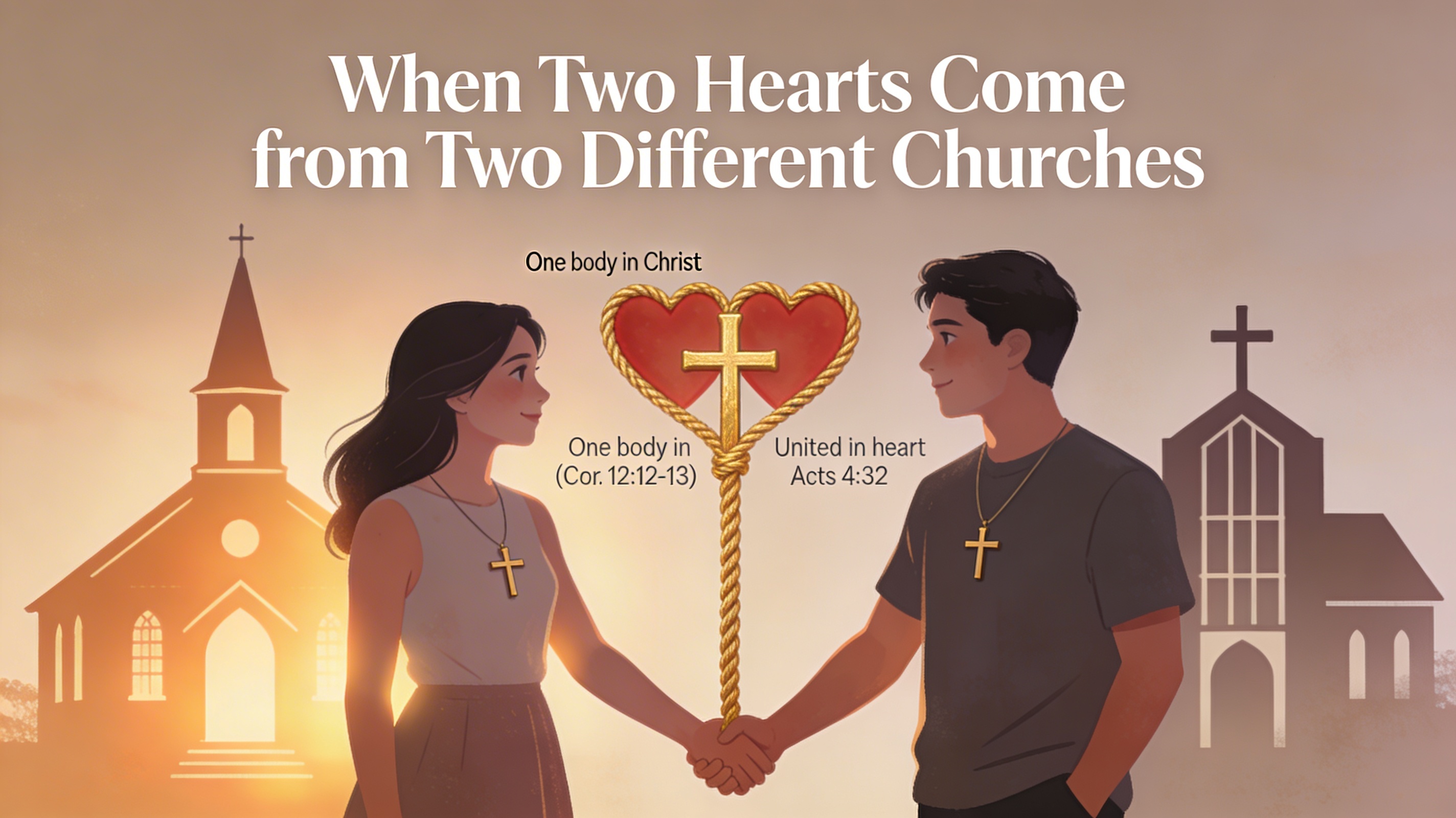
There is a question many believers ask with a sincerity mixed with unease: can one marry someone who attends a different church, who adheres to a different denomination, or even to a doctrine noticeably distant from one's own? The answer is neither a simple "yes" nor a simple "no." It demands that we take the Bible seriously, that we look at the realities of the home with clear eyes, and that we trust divine wisdom rather than the heart's attraction alone.
Unity: The Biblical Foundation of Marriage
From the very first pages of Genesis, God establishes marriage as a total union: "Therefore a man shall leave his father and his mother and hold fast to his wife, and they shall become one flesh" (Genesis 2:24). This "one flesh" does not describe only physical union — it describes a communion of life, vision, values, and, for believers, of faith. The Apostle Paul returns to this image and applies it to the mystery of Christ and the Church (Ephesians 5:31-32), indicating that marriage is a living parable of a profound spiritual reality. This foundation immediately raises a question: how can two spouses embody this parable if they do not share the same understanding of the One whose union their marriage reflects?
What the Bible Says About Doctrinal Difference
The Word of God does not treat the matter of divergence in faith as incidental. It addresses it with a gravity that ought to give us pause.
Amos 3:3poses a rhetorically weighty question: "Do two walk together, unless they have agreed to meet?" Walking together presupposes a prior agreement on direction. In a marriage, that direction is first and foremost spiritual. If one spouse is convinced that the gifts of the Spirit ceased with the death of the apostles, while the other worships in a church where speaking in tongues is central to corporate worship — or if one believes in infant baptism while the other holds to believer's baptism by immersion — these divergences are not liturgical details. They reach into the very way one understands grace, belonging to God, and the upbringing of children.
2 Corinthians 6:14is the most directly relevant passage: "Do not be unequally yoked with unbelievers. For what partnership has righteousness with lawlessness? Or what fellowship has light with darkness?" It is important to understand this verse carefully. Its immediate context concerns the marriage of a believer to an unbeliever — a union Paul firmly discourages. But the principle it establishes — that spiritual compatibility is a prerequisite for shared life — extends logically to the question of significant doctrinal divergence between two Christians. Paul is not speaking here of minor differences in practice, but of a fundamental incompatibility of nature. Between two orthodox Christian confessions, the "yoke" is not necessarily "unequal" — but between two fundamentally opposed visions of salvation, church authority, or the role of the Holy Spirit, the tension can become unbearable.
Romans 15:5-6offers the positive perspective: "May the God of endurance and encouragement grant you to live in such harmony with one another, in accord with Christ Jesus, that together you may with one voice glorify the God and Father of our Lord Jesus Christ." Paul's aspiration is unanimity in praise and theological vision. In a household, this unanimity is both a gift and a daily work. It can be cultivated — but only if both spouses share the same desire to honor Him.
Ephesians 4:3-6presses the point further: "Eager to maintain the unity of the Spirit in the bond of peace. There is one body and one Spirit... one Lord, one faith, one baptism, one God and Father of all." Unity is not optional — it is a vocation. In marriage, this vocation is lived out daily: in shared prayer, in the raising of children, in decisions about the local church, in crises where faith is the only anchor.
The Concrete Challenges of an Inter-Denominational Union
It would be inaccurate to claim that all marriages between Christians of different denominations are doomed to fail. Church history is filled with couples who transformed their differences into richness, developed a fruitful theological dialogue, and found a church that welcomed them both. But it would be equally misleading to minimize the real challenges.
The first challenge isecclesiastical belonging. Which church does the couple attend on Sunday? Who baptizes the children, and in what manner? Under which pastoral authority does the couple place itself to receive guidance? These questions, seemingly minor during courtship, become critical once a family is established. The temptation is strong, for one or the other, to sacrifice personal conviction on the altar of marital peace — which, over time, produces resentment rather than harmony.
The second challenge isthe upbringing of children. In what doctrinal framework will they be raised? How does one explain to them that father believes one thing and mother another? Children need coherence for their faith to take root. A home divided over the foundations of faith exposes children to a confusion that can, in adulthood, translate into religious disengagement.
The third challenge is that ofshared prayer and discernment. When trials come — illness, financial crisis, grief, temptation — it is a shared vision of God that must unite the two spouses in prayer. If one believes in healing prayer with the laying on of hands and the other regards it as a spiritual deviation, the crisis becomes a spiritual battlefield rather than a place of refuge.
Can It Still Work?
Yes — under certain conditions. The first isessential doctrinal proximity: the two spouses must share the foundational truths of the Christian faith — the divinity of Christ, the resurrection, salvation by grace through faith, the authority of Scripture. If these foundations are held in common, differences in liturgical practice or ecclesiastical tradition can be navigated with love and mutual respect.
The second condition ishumility and openness to dialogue. Neither spouse should position themselves as the sole guardian of absolute truth on secondary matters, but both must be willing to deepen their knowledge of the Word together, to study points of disagreement, and to seek a shared conclusion rather than settling into a stagnant détente of peaceful but fruitless coexistence.
The third condition ispastoral accompaniment. An inter-denominational couple needs solid guidance — pastors or elders capable of accompanying them without taking sides for one confession over another, but always directing them back to the Word of God.
Conclusion: Before the Wedding, the Hard Questions
Marriage is not the place where incompatibilities are discovered — courtship is where that work must be done. A believer considering marriage with someone from another denomination must honestly and prayerfully ask the following questions: Are our convictions on the essential points of faith compatible? Are we both willing to unite within the same church community? Do we share the same vision for the Christian upbringing of our children? And above all: does this relationship draw us both closer to Christ, or does it pull us away from Him?
The Bible does not condemn every marriage between believers of different confessions. But it calls us to a profound unity, to a common walk in the same direction. For two cannot walk together unless they have agreed — and in marriage, that agreement must begin long before the altar.