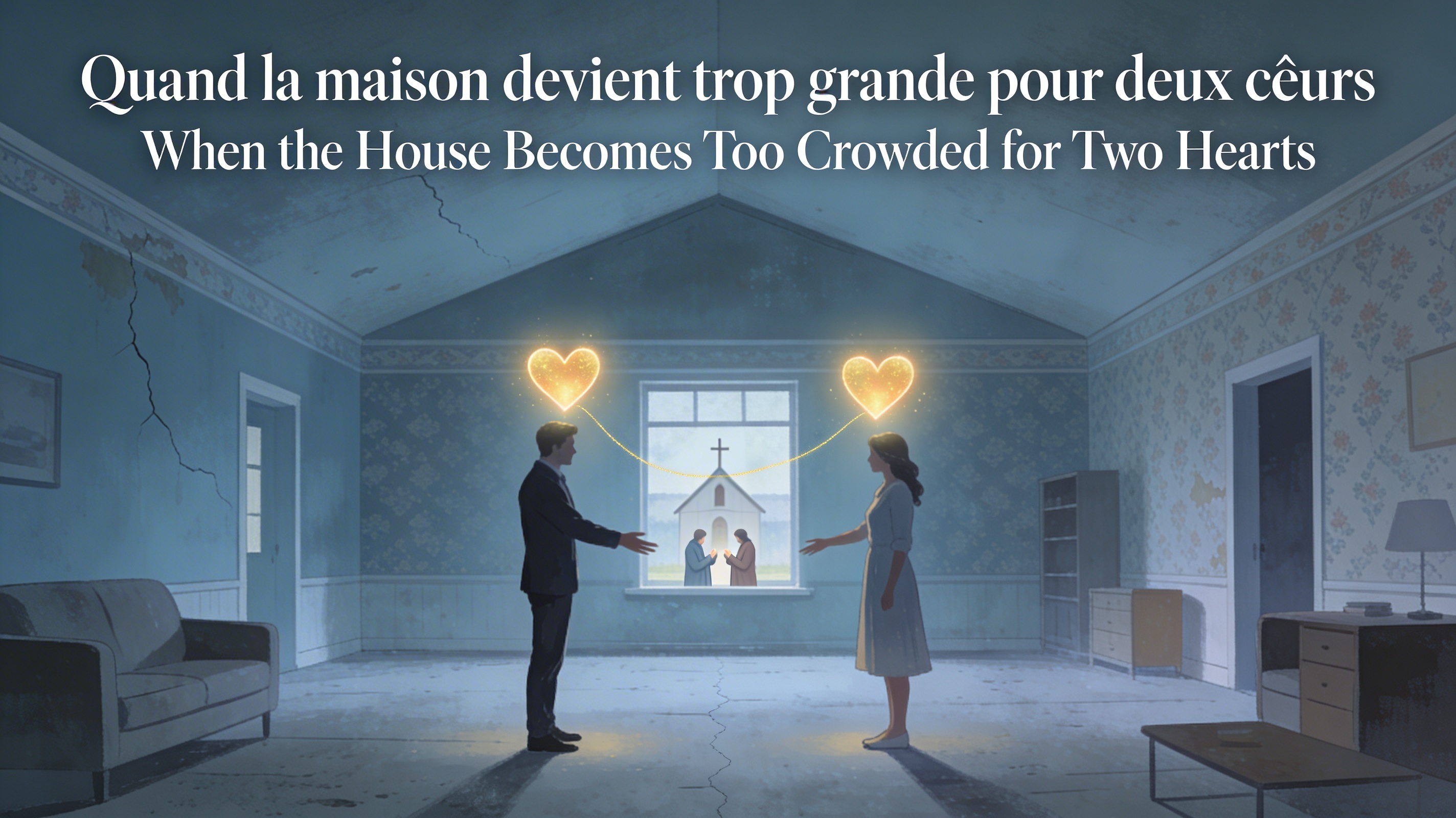
The Story of Hans and Petra
In the beginning, Hans and Petra were what many would have called a blessed couple. Their mornings began with shared prayer, their evenings with soft conversation by the light of a lamp on the kitchen table. Hans worked as a carpenter in the neighborhood; Petra taught the children nearby. Their home — small, bright, and clean — was the sanctuary of their love. Two souls, one roof, one conjugal spirit.
Then came the phone call no one refuses: Petra's cousin, in financial trouble, asked to stay for a few weeks. A few weeks turned into a few months. Shortly after, Hans's brother lost his job and knocked on the door with two suitcases and a dog. Not long after that, Petra's aging and lonely mother came to stay "for a little while." The house that had been built for two souls now sheltered six people, quiet tensions, and eyes that no longer met.
Hans and Petra did not argue. It was worse than that. They stopped talking. There was no longer any space for conjugal whisper, no moment for intimate vulnerability, no table where they could dine alone together. Their marriage — once alive and vibrant — was slowly suffocating beneath the weight of everyone else's needs.
What the Word of God Says
1. Marriage Requires a Courageous Departure
The scriptural foundation of marriage rests on a radical principle established from the very first pages of the Bible:
"Therefore a man shall leave his father and his mother and hold fast to his wife, and they shall become one flesh."— Genesis 2:24
This verse is not merely poetic wedding language. It is a divine ordinance of priority. The Hebrew verbazab— translated "leave" — literally means to abandon, to forsake, to put behind. God himself inaugurates marriage by establishing a boundary: husband and wife must form a distinct unit, separated from previous loyalties — even parental ones — without denying or dishonoring them.
Hans and Petra had forgotten this founding truth. By opening their door to everyone without discernment, they had invited not only people, but old family dynamics, conflicting habits, and needs that steadily encroached upon their vital space. Loving one's neighbor is a commandment. But it cannot be lived at the expense of the primary home God has entrusted to a couple.
2. A Marriage Is a Garden That Must Be Kept
The Song of Solomon offers a striking image of marital intimacy:
"A garden locked is my sister, my bride, a spring locked, a fountain sealed."— Song of Solomon 4:12
The locked garden is not an image of hostile exclusion. It is an image of sacred protection. In Hebrew culture, a walled garden was a cultivated, precious space — protected from animals and intruders — so that what grew within could flourish fully. Marital intimacy — physical, emotional, and spiritual — is that garden. It requires walls, not out of pride, but out of wisdom.
In Hans and Petra's home, the garden had lost its walls. Every corner of their private life was now traversed, commented upon, and invaded. Petra's cousin offered unsolicited opinions on their finances. Hans's brother occupied the living room from dawn. Petra's mother weighed in on their daily decisions. The garden was no longer a garden — it had become a public square. And in a public square, nothing grows with lasting depth.
3. Loving Without Losing Yourself: The Wisdom of Limits
The apostle Paul, writing to the Corinthians about the realities of marriage, reminds us of an often-overlooked truth:
"For the wife does not have authority over her own body, but the husband does. Likewise the husband does not have authority over his own body, but the wife does."— 1 Corinthians 7:4
This verse speaks of mutual priority and reciprocal belonging. Husband and wife owe themselves to one another — their presence, their attention, their availability — before offering these to anyone else. Family generosity is a Christian virtue. But it cannot be practiced to the point where both spouses no longer find each other, no longer truly see each other, no longer belong to each other.
What Hans and Petra were experiencing was not holiness. It was conjugal exhaustion disguised as hospitality. True biblical hospitality does not destroy the home that welcomes — it strengthens it, because it flows from a couple that is strong, clear-eyed, and united.
The Path Toward Restoration
Hans and Petra did not need to expel their relatives harshly. They needed to find their shared voice again. One evening — sitting face to face for the first time in a long while — they spoke honestly with each other. Together, in prayer, they decided to set clear timelines with their family members, to protect inviolable moments for their couple alone, and to seek pastoral counsel to navigate this difficult season.
The healing of a marriage does not begin with a grand gesture. It begins with a courageous conversation, illuminated by the Word, carried by grace. Hans took Petra's hand. And for the first time in months, they truly looked at each other