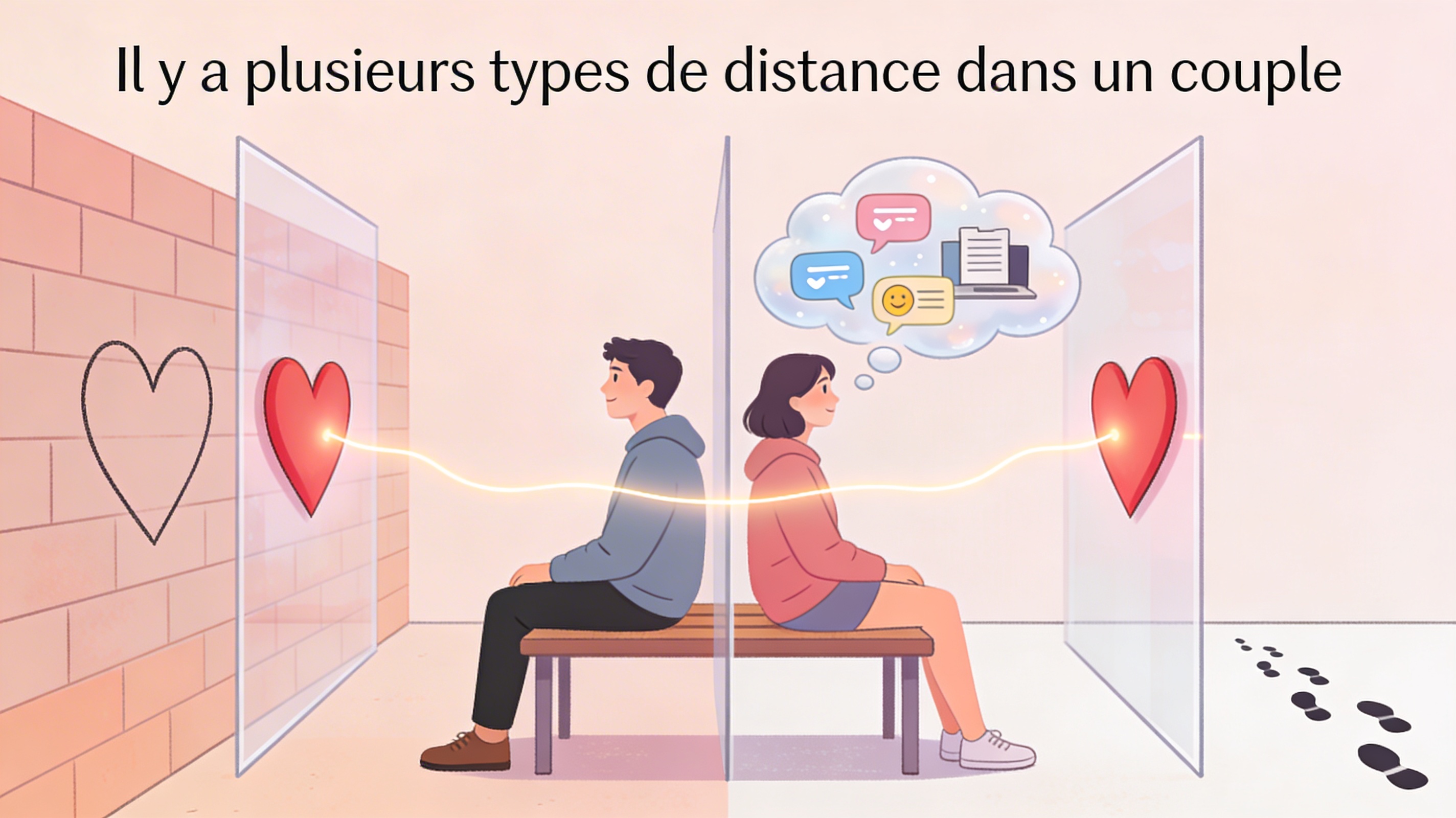
You sleep in the same bed. You eat at the same table. You share the same bills, the same roof, sometimes even the same children. And yet there is something between you that you can't quite name. A kind of empty space. A transparency where there should be warmth. You're not separated. Not yet. But you're not really together anymore either. What you're experiencing is distance. And contrary to what people often believe, distance in a relationship isn't measured in miles.
Physical distance — the kind that comes from a job abroad, a hospitalization, a forced migration — is the most visible. It's painful, but it has one advantage: you can see it. You can name it. You can work on it. The problem is that most couples who suffer aren't suffering from physical distance. They're suffering from invisible distances, the ones that settle in without being invited, without being noticed, until the day they occupy all the space.
Emotional distance: when silence replaces words
The first invisible distance is emotional distance. It begins with small things. You stop telling each other about your day. You answer the other's questions with yes or no. You stop sharing what truly moves you — your fears, your doubts, your joys, your wounds. And very quickly, you become two polite strangers managing a shared logistics operation: the children, the groceries, the rent.
What makes emotional distance so dangerous is that it looks like peace. No arguments, no crises, no tears. Just silence. A silence that is comfortable on the surface and deadly at depth. Couples live entire years in this state, convinced that the absence of conflict means everything is fine. The Bible calls it something different. It calls it hardening of the heart. And it speaks of it as a spiritual danger, not just a relational one.
"But watch yourselves lest your hearts be weighed down with dissipation and drunkenness and cares of this life." — Luke 21:34
What Jesus describes here is a heart numbed by daily life. A heart that stops feeling. In a couple, this is exactly what happens when emotional distance sets in: you end up feeling nothing for the other. Not hatred. Just indifference. And indifference is more fatal than anger.
Restoring emotional distance requires courage. Not romance. Courage. The courage to say to the other: "I feel like we've lost each other." The courage to be vulnerable when everything in you wants to protect itself. It's uncomfortable. It's necessary.
Intellectual distance: when you stop surprising each other
The second form of distance is less well known, but just as formidable. It's intellectual distance. It sets in when two people stop growing together, stop challenging each other, stop surprising each other. At the beginning of a relationship, you talked about everything: your dreams, your convictions, what you wanted to build. Over time, conversations shrink down to managing daily life.
This distance is often the product of mutual complacency. You assume the other already knows what you think. You assume you know each other so well there's nothing left to discover. This is a fatal mistake. A human being is not a fixed formula. They evolve, change, mature. A spouse who no longer seeks to know the other as they are today — not as they were ten years ago — is living with an image, not a person.
Proverbs 27:17 says that "iron sharpens iron." It's an image of productive friction. Two people who intellectually challenge each other, who question each other, who don't let each other stagnate. When this friction disappears, when everything becomes smooth and familiar, intellectual distance takes the place of dialogue. And with it comes an existential boredom that pushes some people to seek elsewhere the stimulation they no longer find at home.
Spiritual distance: the most silent and the most devastating
There is a third distance, the one most rarely named in Christian couples, precisely because it's the most frightening to admit. It is spiritual distance. It occurs when two people who made promises before God stop walking together toward Him. One still prays. The other has stopped. One is moved by a verse. The other doesn't care. One feels the conviction of the Holy Spirit. The other is elsewhere.
This distance is particularly destructive because it strikes at the very foundation of what a Christian marriage is meant to be. The Bible does not present marriage as a partnership of two autonomous individuals. It presents it as a three-party covenant: him, her, and God at the center. When God leaves the center — or rather, when the couple sets Him aside — the two spouses face each other without mediation, without shared anchor, without the resource that allowed them to forgive, to persevere, to love each other beyond their limitations.
"Two are better than one, because they have a good reward for their toil. For if they fall, one will lift up his fellow. But woe to him who is alone when he falls and has not another to lift him up." — Ecclesiastes 4:9-10
This passage speaks of mutual support. But there is an implied dimension that many ignore: two who walk together go in the same direction. When the spiritual direction in a couple diverges, this unity of movement breaks. And lifting each other up becomes impossible when you no longer know where you're going yourself.
Spiritual distance manifests through concrete signs. You no longer pray together. You no longer open the Bible together. You may still go to church together, but you come back without having shared anything. You avoid conversations about God because they end in disagreement or discomfort. And progressively, what was meant to be the central pillar of your union becomes a taboo subject.
Physical distance: real, but often overestimated
We return to physical distance — the only one that couples readily acknowledge. It is real. It is painful. A long-distance relationship, a military spouse, a separation due to immigration or incarceration: all of this creates legitimate suffering that the Bible does not minimize.
But here is what pastoral practice and relational experience confirm: couples thousands of miles apart from each other can be emotionally close, intellectually alive, spiritually aligned. And couples under the same roof can be complete strangers. Physical distance is an external constraint. The other distances are choices — slow choices, often unconscious, but choices nonetheless.
Getting out of distance: it's not just a question of willpower
Many couples who read this kind of article say to themselves: "That's us." And immediately after, they think: "We'll try to do better." Then nothing changes. Because distance in a couple is not resolved by willpower alone. It's resolved by a radical decision to turn back toward each other — what the Bible calls teshuvah, a turning, a conversion of the heart.
"Return to me, and I will return to you, says the Lord of hosts." — Malachi 3:7
This verse is addressed to Israel, but its principle applies to marriage. God himself uses the metaphor of the marital relationship to describe his covenant with his people. And what he asks for is not a gradual effort. It's a turning. A deliberate choice to come back, even when it's hard, even when the emotions haven't caught up yet.
Distance in a couple doesn't disappear the night you decide it must. But it begins to retreat the night you take that first step — a sincere question, a prayer spoken aloud, an honest conversation about what you've been feeling for months. These small acts seem like nothing. They are everything.
What you allow to grow in your marriage ends up occupying all the space. Distance doesn't shout. It settles in quietly, comfortably, until it becomes the normal landscape of your life together. The good news is that what settled in gradually can also retreat gradually. But not without a decision. Not without honesty. And for Christian couples, not without putting God back where He should never have left: at the center.