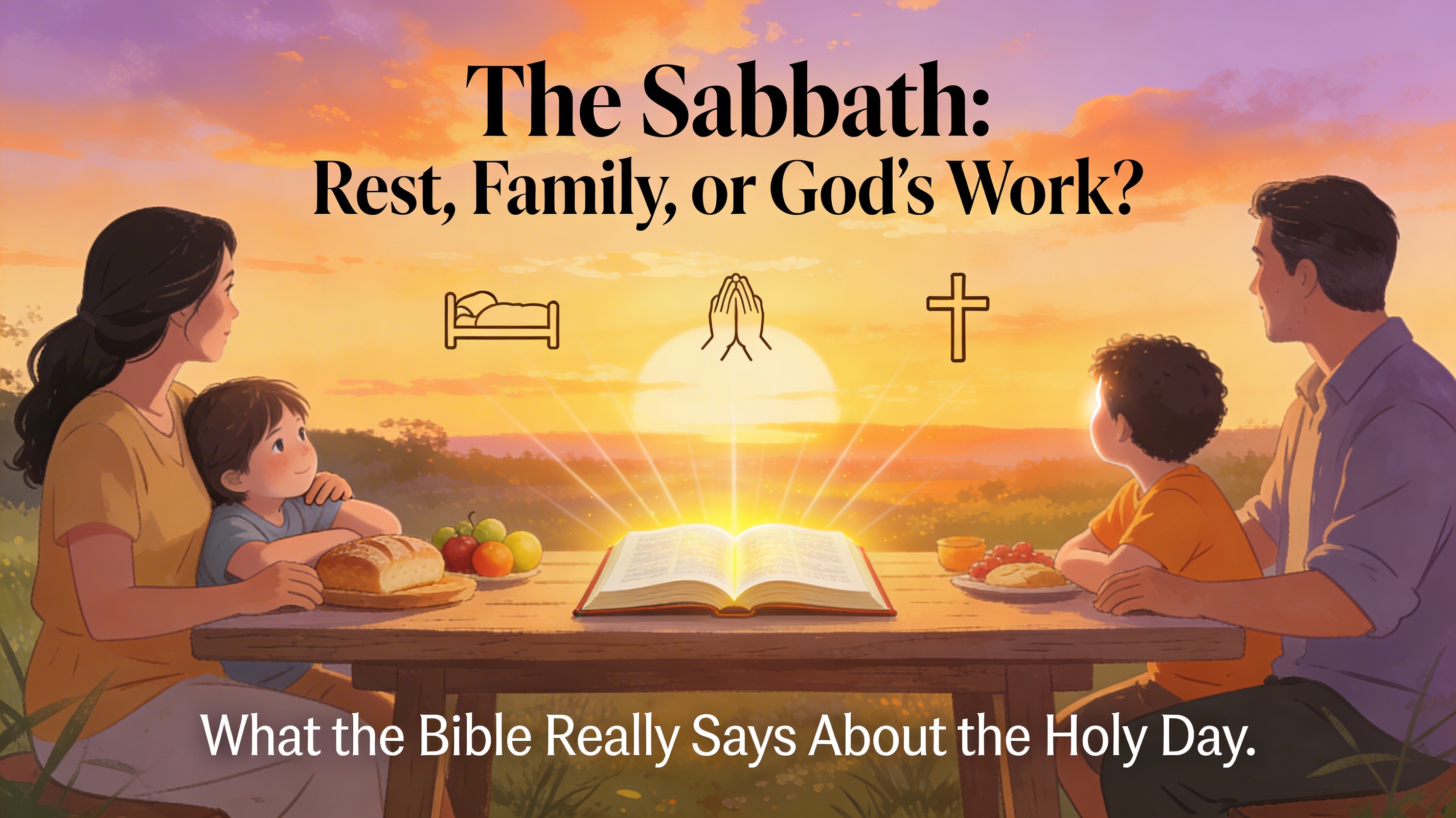
There is a question many sincere believers carry without quite daring to articulate it: what am I actually supposed to do on the Sabbath? Some spend it entirely at church — morning meetings, afternoon gatherings, evening services — and come home exhausted. Others use the day to rest with family, but carry a vague sense of guilt, as if they are missing something. Others still get lost in debates about which day is the "true" Sabbath — Saturday or Sunday. Scripture deserves to be read carefully on this point — not to settle calendar disputes, but to recover what God had in mind when He consecrated this day since the very creation of the world.
The Origin of the Sabbath: God's Gesture Before a Commandment for Man
The Sabbath was not born at Sinai. It was born at creation.
Genesis 2:2-3says: "And on the seventh day God finished his work that he had done, and he rested on the seventh day from all his work that he had done. So God blessed the seventh day and made it holy, because on it God rested from all his work that he had done in creation."
Three verbs structure this foundational text: God rested, He blessed, He made holy. God's rest is not fatigue — it is contemplation. It is the moment where He pauses over what He has made and declares it good. The blessing indicates that this day carries a particular fruitfulness. The sanctification means it is set apart, made different from every other day. Before Israel existed, before man had sinned, God inscribes into the rhythm of creation a space of pause, presence, and contemplation.
The Sabbath is therefore not first and foremost a law. It is a rhythm embedded in the structure of time itself. The person who ignores the Sabbath is not merely transgressing a commandment — they are disconnecting from a creational rhythm that God himself inhabited.
The Commandment at Sinai: Total Rest, and for Everyone
Exodus 20:8-10formalizes this rhythm into commandment: "Remember the Sabbath day, to keep it holy. Six days you shall labor, and do all your work, but the seventh day is a Sabbath to the Lord your God. On it you shall not do any work, you, or your son, or your daughter, your male servant, or your female servant, or your livestock, or the sojourner who is within your gates."
The list is deliberately exhaustive. Sabbath rest is not a privilege reserved for free men in good health. It extends to children, servants, foreigners, and animals themselves. It is a radical declaration of equality in rest: on that day, no one is defined by their productivity. Neither the master nor the slave. The Sabbath is, in its very essence, a day that liberates — that suspends the hierarchies of work and reminds us that the value of a human being does not lie in what they produce.
For the family, this is foundational. The father who works without ceasing, the overwhelmed mother, the children shuttled from one activity to the next — the Sabbath is made for them. It is the day when tools are set down, when people find each other again, when they breathe together. This is not a concession to bourgeois comfort. It is a divine prescription for the health of the family.
Jesus and the Sabbath: Neither Abolition nor Legalism
The great tension around the Sabbath in the New Testament erupts in the confrontations between Jesus and the Pharisees. They had erected around the Sabbath a wall of 39 categories of forbidden work, with their subdivisions and exceptions — a casuistry that had transformed God's gift into an administrative burden.
Mark 2:27-28records this luminous and definitive response from Jesus: "The Sabbath was made for man, not man for the Sabbath. So the Son of Man is lord even of the Sabbath."
Jesus does not abolish the Sabbath — He recenters it. The Sabbath is in the service of mankind, not the other way around. It is made for the good of the creature — for restoration, freedom, and joy. This verse prohibits two symmetrical extremes: the legalistic excess that turns the Sabbath into a cage of paralyzing rules, and the liberal excess that turns it into an ordinary day on the grounds that grace has abolished everything. Jesus heals on the Sabbath — not to desecrate it, but to show that the restoration of the human being is precisely at the heart of what this day means.
"God's work" on the Sabbath, according to Jesus, is healing, liberation, and presence to others. Not the accumulation of religious activities that exhaust as much as ordinary work does.
The Sabbath as Anticipation of Eternal Rest
Hebrews 4:9-10opens an essential eschatological perspective: "So then, there remains a Sabbath rest for the people of God, for whoever has entered God's rest has also rested from his works as God did from his."
The author of Hebrews teaches that every earthly Sabbath is a rehearsal, a foretaste of the great rest into which God invites us to enter definitively. Sabbath rest is not passive — it is an act of faith. To rest on the seventh day is to confess that one is not the engine of the universe, that God holds the world when we stop working, that our value is not conditioned by our performance. It is to practice trust in God concretely.
Lived this way, a Sabbath day spent with family is not a desertion of God's service. It is a living proclamation that one believes in a God who provides, who is sufficient, who reigns — even when our hands are still and our calendars are closed.
So: Family or God's Service?
The honest answer is: both — and one does not oppose the other.
The Sabbath is a day ofcorporate worship. The gathering of God's people — Sunday for most Christians — is a central component of this day. Scripture does not valorize a Sabbath lived in isolation or purely in the private sphere. "Let us not neglect to meet together," says the author of Hebrews (10:25). Corporate worship is not optional for the believer — it is the moment when the body of Christ manifests itself, is nourished, and is strengthened together.
But the Sabbath is also a day ofdeep family rest. Once worship has been celebrated, the time belongs to restoration — of bodies, relationships, and souls. Eating a meal together without screens. Walking together. Playing with children. Visiting elderly parents. Reading Scripture aloud as a family. These are Sabbath acts. They are no less holy than the singing of a hymn.
The danger is twofold. On one side, some communities have turned the Sabbath into a religious marathon — stacked meetings, committees, temple service from dawn to dusk — so that the day of rest becomes the most exhausting day of the week. This is a betrayal of the original meaning of the Sabbath. Jesus himself withdrew to pray, sat down to eat, accepted the hospitality of others. He did not spend every Sabbath in working meetings.
On the other side, reducing the Sabbath to a simple day of personal relaxation — without worship, without community, without a vertical dimension — impoverishes the soul and isolates the believer from their ecclesial body. Rest without the presence of God is merely a pause — not a Sabbath.
How to Live the Sabbath with Integrity Today
A few practical principles, rooted in Scripture:
Begin with worship.The encounter with God within the community is the pivot of the day. It orients everything else. Do not sacrifice it to a morning sleep-in or household chores.
Truly set down your tools.The Sabbath requires a decision. Close the work computer. Turn off notifications. Be present — physically, mentally, emotionally — to those who are with you.
Do good when the occasion arises.Jesus healed on the Sabbath. Helping a neighbor in need, welcoming a stranger, visiting the sick — this is not "working" in the sense the Sabbath forbids. It is precisely what the Sabbath frees in us.
Take joy together.The Sabbath is not austere. It is the day of gladness. A good meal, a family game, a walk, a book read together — all of this participates in the sanctification of the day when lived in gratitude toward God.
Conclusion: The Sabbath Is a Gift, Not a Box to Check
The Sabbath is not an administrative obligation one fulfills to have a clear conscience. It is God's gift to mankind — a space of grace in time, a holy parenthesis where we remember who we truly are: created beings, loved, called to rest and to joy, and not machines of production. Living the Sabbath with family is practicing the Gospel at home. Living the Sabbath in community is testifying before the world that our identity does not reduce to what we produce.
Both together — that is the Sabbath in its fullness.