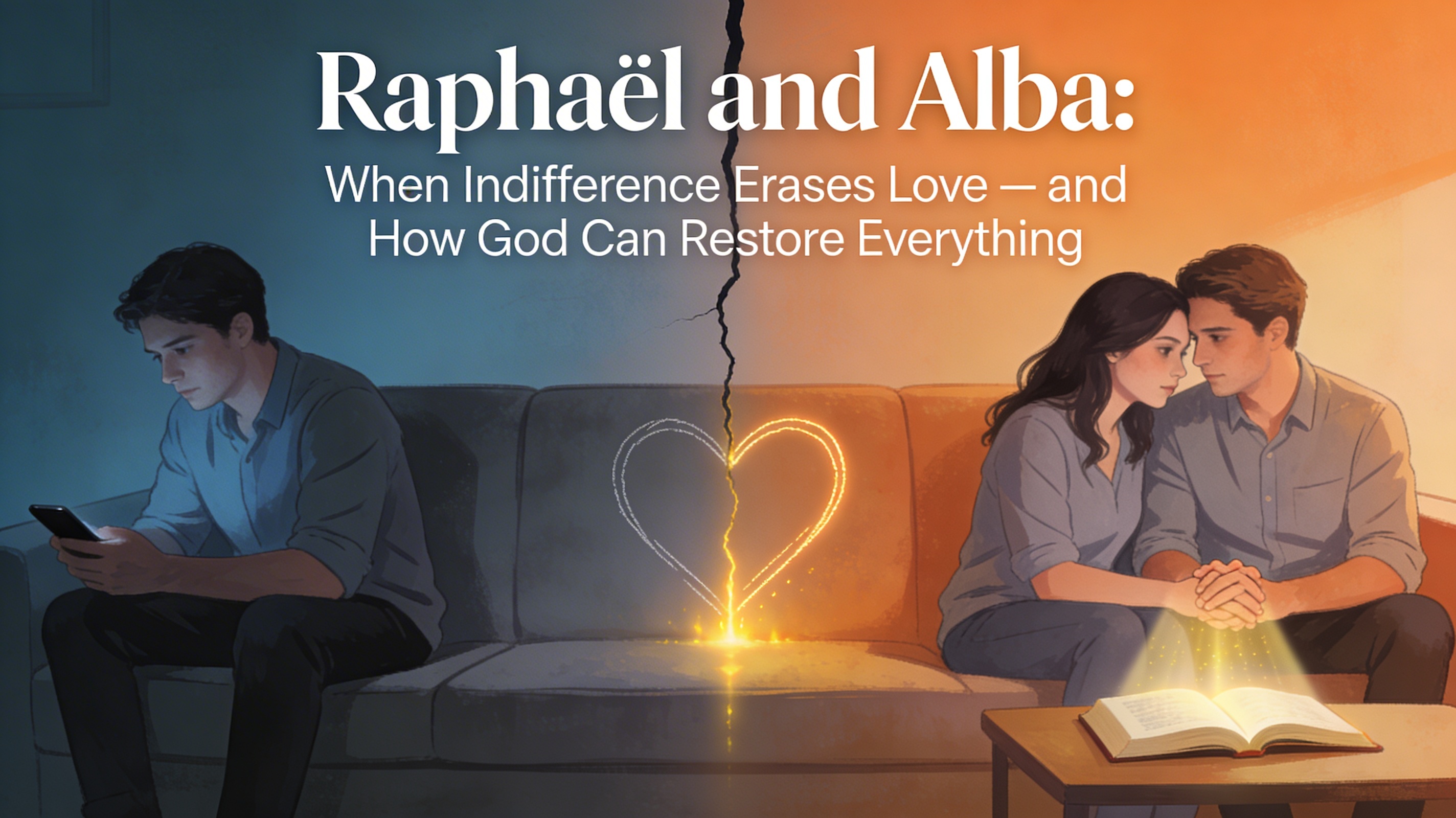
They had stopped arguing. That was perhaps the most alarming sign. Raphaël and Alba had moved through the early years of their marriage with the intensity that belongs to couples who truly love — disagreements, reconciliations, shared plans, nights talking until dawn. Then something had shifted. Not suddenly. More like light fading when no one thinks to turn on the lamps, until the darkness is complete.
They shared the same roof, the same table, sometimes the same bed. But they no longer truly saw each other. Raphaël came home from work and settled in front of his screen. Alba managed the children, the groceries, the daily logistics, in a functional silence that had long since ceased to be peaceful. They coexisted. That is not the same thing as loving.
The day everything collapsed was not dramatic. It was an ordinary dinner, one silence too many, and Alba saying quietly what both had been thinking for months:"I don't know if you're still here."Raphaël did not respond. And that silence was itself an answer.
Indifference: the quiet sin no one names
Much is said about adultery, violence, and betrayal in marriages. These fractures are visible, nameable, condemnable. Indifference, on the other hand, slips under the radar. It makes no noise. It leaves no marks. And yet it destroys with remarkable efficiency, precisely because it is slow and disguises itself easily as fatigue, routine, or the supposed wisdom of long-married couples.
Marital indifference is the gradual withdrawal of attention, tenderness, and curiosity toward the other. It is ceasing to wonder how one's spouse is really doing, what one's wife or husband truly feels inside. It is treating the other like a piece of familiar furniture rather than a living, complex, precious person. And the Bible has something very precise to say about this.
What the Word Says to Raphaël and Alba
1. Love Is Not a Feeling — It Is a Daily Decision
The apostle Paul, in his first letter to the Corinthians, draws a portrait of what love truly is. Among its characteristics, he writes:
"Love is patient, love is kind. It does not envy, it does not boast, it is not proud. It does not dishonor others, it is not self-seeking, it is not easily angered, it keeps no record of wrongs."— 1 Corinthians 13:4–5
This text is often read at weddings as beautiful poetry. In reality, it is a demanding program. Paul is not describing here a feeling one either has or does not have depending on mood — he is describingacts,behaviors,choices. Patience is not natural; it is chosen. Kindness does not arise spontaneously after fifteen years of marriage and two exhausting children; it is decided, day after day.
What Raphaël and Alba lost was not love in its essence, but the practice of love in their daily life. They stopped choosing each other. Not out of malice, but out of neglect — which Scripture does not excuse any more than deliberate harm. The good news in this verse is that it opens a door: if love is a practice, it can be taken up again. It can begin again. It does not depend on what one feels that particular morning, but on what one decides to do with the day.
2. God Sees What People No Longer See
The book of Lamentations is one of the most painful texts in all of Scripture. It is written by a man who contemplates the ruins of everything he loved. And yet, at the very heart of that desolation, one of the most luminous affirmations in the Bible breaks through:
"Because of the Lord's great love we are not consumed, for his compassions never fail. They are new every morning; great is your faithfulness."— Lamentations 3:22–23
There is something profoundly pastoral in this verse for a couple like Raphaël and Alba. When two people have stopped seeing each other, when indifference has thickened the wall between them to the point where it seems indestructible, God does not stop seeing. His compassions do not wear thin as human love wears thin. And they arenew every morning— which means that every day that dawns is an opportunity that God himself offers for a new beginning.
This verse does not promise that restoration will be easy. It promises that it is possible, because the God of faithfulness stands on the side of those who still want to try. Raphaël and Alba do not have to draw from their own depleted reserves: they can lean on the compassion of a God who renews what human beings allow to wither.
3. A Word Spoken in Time Can Change Everything
The Gospel of John records a scene of disarming simplicity, by the shore of a lake, after the resurrection. Peter had denied Jesus three times. He lives with that shame. And Jesus does not ignore it, does not pretend nothing happened. He returns to the wound — three times — with the same insistent question:
"When they had finished eating, Jesus said to Simon Peter, 'Simon son of John, do you love me more than these?' 'Yes, Lord,' he said, 'you know that I love you.'"— John 21:15
What is remarkable about this exchange is that Jesus asks. He does not assume. He does not presume that Peter still loves him, or that everything is already repaired. He asks the question, three times, with a persistence that is itself a form of love. And this question opens a space — the space in which Peter can name himself, explain himself, be restored.
For Raphaël and Alba, this scene is a quiet lesson. The restoration of a couple does not begin with grand gestures or theoretical resolutions. It begins with a question asked in sincerity:do you still love me? Are you still there? Do you want us to try again?These questions are frightening because they expose. But they are the ones that open the door. Jesus himself teaches us: one must have the courage to name what one can no longer see, in order to have a chance of finding it again.
When God Is There: Restoration as a Process
The evening Alba said"I don't know if you're still here,"something broke. But something also opened. That kind of painful admission, spoken quietly above a cold plate of food, is often the first honest word a couple has spoken in a very long time. It is the moment when indifference retreats — not because it has been defeated, but because it has been named.
God is precisely there in moments like these. Not as a distant spectator, but as the one of whom Lamentations says that his compassions are renewed every morning. The restoration of a couple like Raphaël and Alba does not happen overnight. It passes through daily decisions — choosing to look at the other again, asking a question and genuinely waiting for the answer, stepping out of one's own bubble for one screen-free dinner, saying out loud what one feels rather than letting it die in silence.
It also often passes through a trusted third party — a pastor, a couples' counselor, a Christian therapist — who can help untangle what two people alone can no longer unravel on their own.
Conclusion: What God Does with Ruins
Raphaël and Alba are not condemned by their indifference. They are invited, like Peter on the shore, to answer a question that God himself puts to every couple that has lost its way:do you still want to try?God's grace does not make things easy. It makes them possible. And sometimes, that is all a couple needs to begin again — not to recover the feelings of years ago, but to decide together to walk toward each other once more, one morning after another, sustained by the faithfulness of a God who never grows weary.