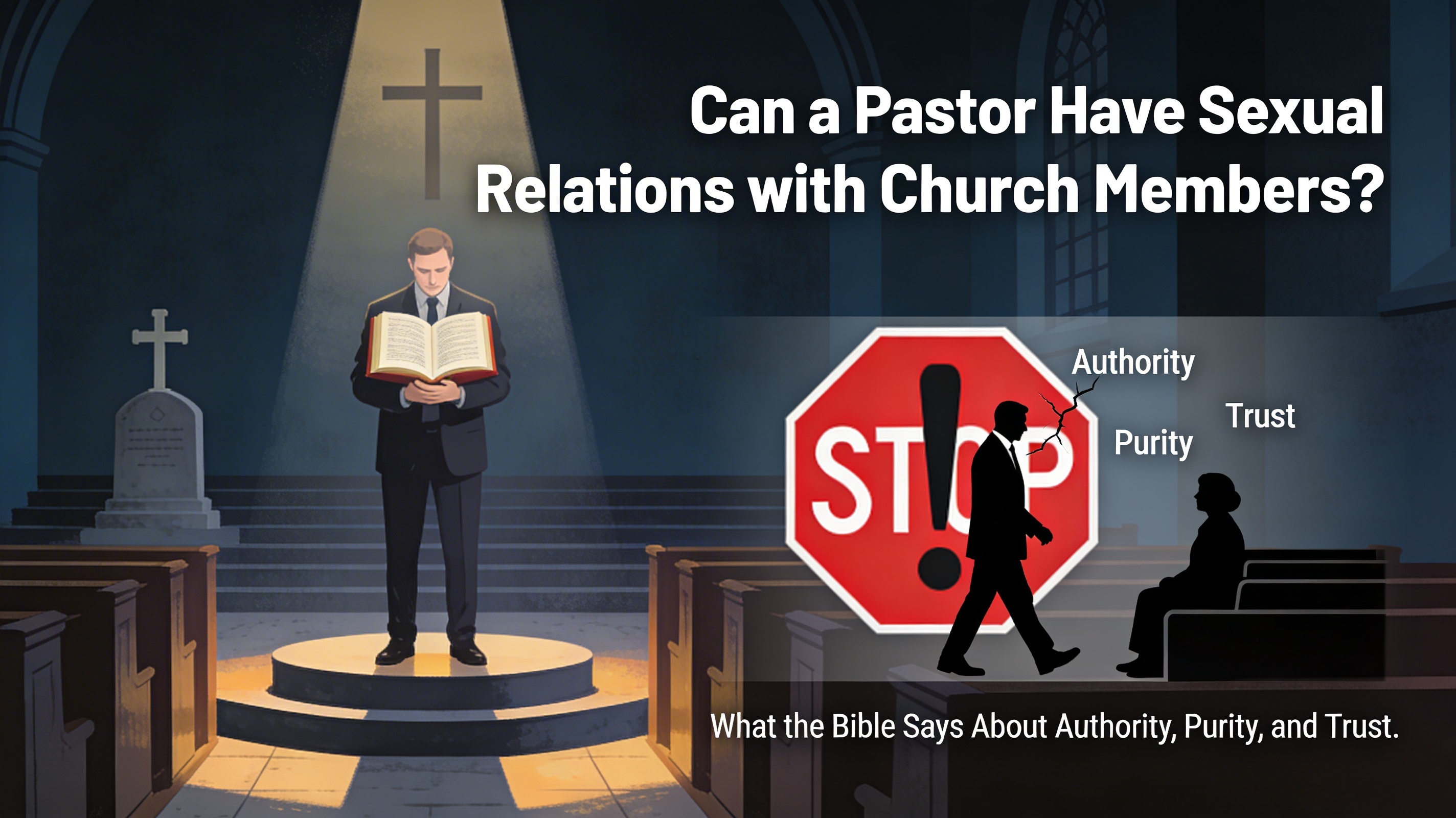
The question may seem shocking to state openly. Yet it deserves a clear, well-grounded, and Scripture-anchored answer — precisely because the Church's silence on this subject has, over the centuries, allowed countless abuses to remain hidden. Believers have been wounded, manipulated, and spiritually devastated by men who wore the garments of ministry while betraying their calling in secret. The Bible is not silent on this question. It speaks with authority, clarity, and compassion.
The Context: Why This Question Is Not Ordinary
We must first understand why a sexual relationship between a church leader — whether priest, pastor, elder, or evangelist — and a member of the congregation is never simply a matter "between consenting adults." The pastoral relationship is structurally asymmetrical. The minister represents God in the eyes of the faithful. He or she knows the secrets of conscience, the intimate wounds, the deep doubts of those entrusted to them. This position of trust and spiritual authority creates a power dynamic that renders any "consent" profoundly ambiguous — and, in the truest sense, impossible.
Psychologists and theologians agree on this point: in a relationship where one party holds spiritual authority over the other, the very notion of free consent is compromised. This is why the codes of ethics governing helping professions — physicians, therapists, social workers — universally prohibit sexual relationships with their patients or clients. Pastoral ministry is no different; if anything, it is even more delicate, because it engages the soul and not merely the body or mind.
What the Bible Teaches
1. The Shepherd Is Called to Serve, Not to Exploit
Ezekiel 34:2-4is one of the most severe passages in all of the Old Testament against shepherds who abuse their position: "Son of man, prophesy against the shepherds of Israel; prophesy, and say to them, even to the shepherds: Thus says the Lord God: Ah, shepherds of Israel who have been feeding yourselves! Should not shepherds feed the sheep? You eat the fat, you clothe yourselves with the wool, you slaughter the fat ones, but you do not feed the sheep. The weak you have not strengthened, the sick you have not healed..."
This passage speaks of shepherds who use the flock for their own benefit — to feed themselves, to enrich themselves, to satisfy themselves — rather than protecting and nourishing those in their care. The metaphor applies directly to the minister who uses their position to satisfy sexual desires. They are "feeding themselves" at the expense of those entrusted to them. God, in this text, does not speak gently — He pronounces: "Woe."
2. The Qualifications of Church Leadership Require Self-Control
1 Timothy 3:2-3sets out the criteria every church leader must meet: "Therefore an overseer must be above reproach, the husband of one wife, sober-minded, self-controlled, respectable, hospitable, able to teach, not a drunkard, not violent but gentle, not quarrelsome, not a lover of money."
The phrase "husband of one wife" — in Greek,mias gunaikos andra, literally "a man of one woman" — means far more than a simple rule about the number of marriages. It describes a man whose sexual and emotional fidelity is complete and unambiguous. A church leader who engages in sexual relations outside of marriage — with a congregation member, a parishioner, or anyone else — directly violates this requirement. They disqualify themselves from ministry, not according to an arbitrary human judgment, but according to the criteria God himself established through his apostle.
3. The Call to Absolute Purity in Ministry
1 Thessalonians 4:3-7is explicit: "For this is the will of God, your sanctification: that you abstain from sexual immorality; that each one of you know how to control his own body in holiness and honor, not in the passion of lust like the Gentiles who do not know God; that no one transgress and wrong his brother in this matter, because the Lord is an avenger in all these things... For God has not called us for impurity, but in holiness."
This passage expressly forbids "wronging" and "transgressing against" a brother or sister in matters of sexuality. In a pastoral context, this command takes on an even graver dimension: the minister possesses intimate knowledge of the believer's vulnerabilities. To use that knowledge for sexual purposes is not merely immorality — it is deliberate deception, a betrayal of trust that God here describes as something "the Lord avenges."
4. Jesus and the Gravity of Causing the Vulnerable to Stumble
Matthew 18:6records these words of Jesus: "But whoever causes one of these little ones who believe in me to sin, it would be better for him to have a great millstone fastened around his neck and to be drowned in the depth of the sea."
The "little ones" Jesus speaks of are not only children in the literal sense. They are all those who find themselves in a position of vulnerability within the community of faith — those who believe, who trust, who are fragile on their spiritual journey. A believer who comes seeking pastoral help is precisely in that position of vulnerability. Jesus uses an image of extreme symbolic violence to convey the horror he regards it as to cause one who trusts him to stumble, to be wounded, to be ensnared. The minister who abuses their position commits exactly this scandal that Jesus condemns without equivocation.
The Forms of Abuse and Their Common Rationalizations
It is necessary to name the rationalizations frequently heard in these situations — precisely in order to dismantle them.
"It was consensual."As explained above, consent within a relationship of spiritual authority is structurally compromised. The vulnerable person may sincerely believe that the relationship is desired by God — especially if the minister implies as much. This belief is manipulation, whether conscious or unconscious.
"We genuinely loved each other."Feelings do not legitimize what is contrary to the Word of God. The sincerity of an emotion is not sufficient to justify a relationship that betrays a calling, breaks commitments, and wounds an entire community.
"No one was hurt."Research on pastoral abuse consistently demonstrates that victims carry deep and lasting wounds — not only psychological, but spiritual. Many leave the faith. Many never return to a church. The damage is real, even when it is not immediately visible.
Responsibility, Repentance, and Restoration
What happens when such an abuse has occurred? The Bible calls for several distinct responses.
First,the truth must be told. The Church cannot protect its image at the expense of truth. Institutional silence in the face of pastoral abuse is itself a collective sin.
Second,the offending leader must be removed from their position. Paul is clear in 1 Timothy 5:20: "As for those who persist in sin, rebuke them in the presence of all, so that the rest may stand in fear." Transparency is not cruel — it is protective for the entire flock.
Third,the victim must be accompanied, believed, and supported. Too often, the Church has done the opposite — protecting the minister and marginalizing the wounded person. This reversal is a second betrayal that Scripture cannot sanction.
The minister's repentance, if sincere, may open a path toward forgiveness — but it does not automatically restore them to ministry. Some consequences are lasting. This is the price of trust betrayed.
Conclusion: The Holiness of Ministry as Protection for the Faithful
A pastor, a priest, an elder — any church leader — has no right to engage in sexual relations with members of their congregation. This is not an arbitrary rule of human tradition. It is the direct implication of what the Bible teaches about the shepherd, about self-control, about holiness, and about the gravity of causing the vulnerable to stumble.
Ministry is a sacred service. Its strength rests on trust. And trust, once broken in this way, leaves wounds that only the grace of God — and a Church courageous enough to speak the truth — can begin to heal.