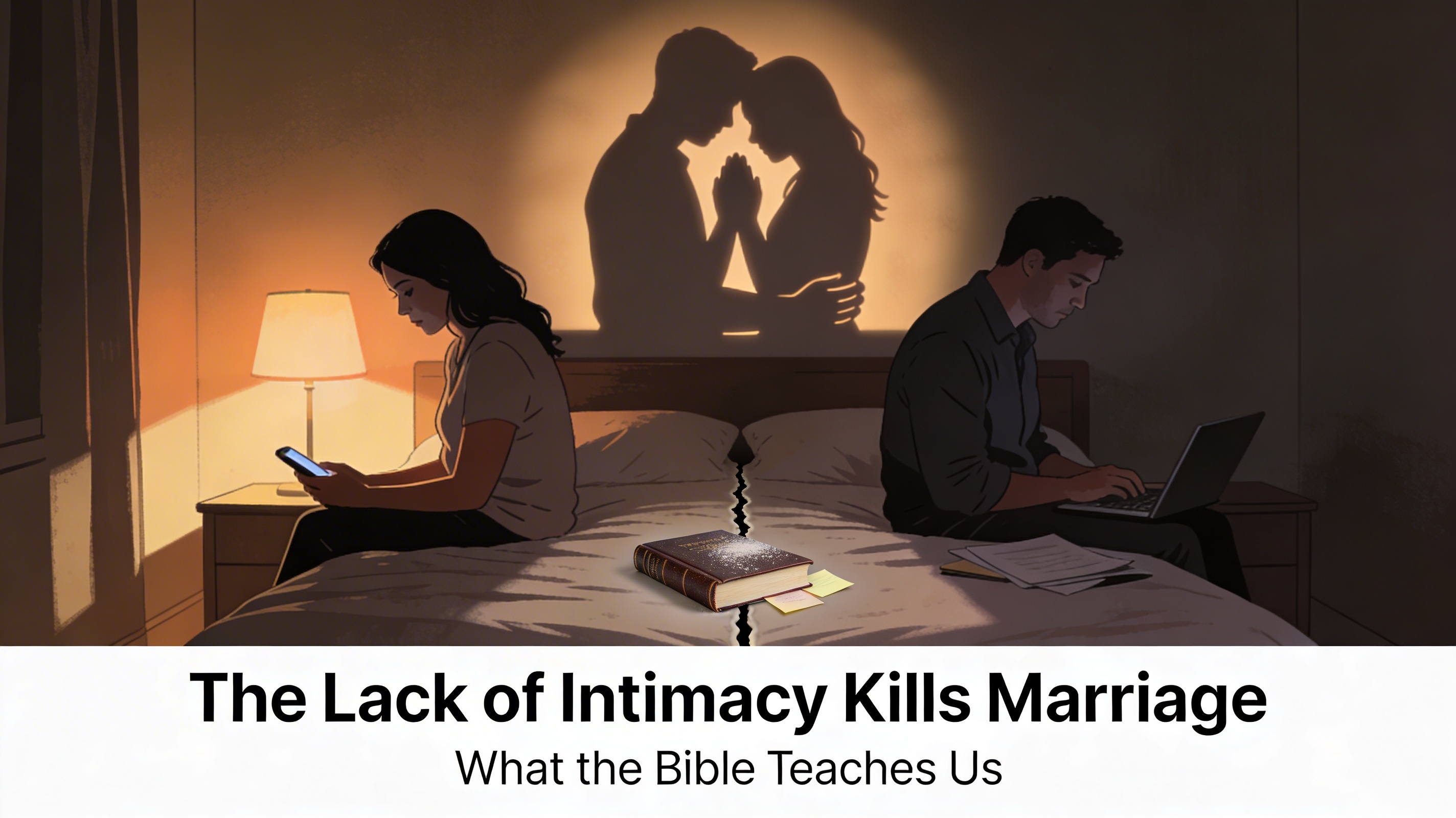
Some marriages do not end in a dramatic divorce. They die slowly, silently, in the distance that settles between two people who share the same roof but no longer truly touch each other — not in body, not in heart, not in soul. This slow fading of intimacy is one of the most underestimated causes of marital destruction. It is rarely spoken of, because it leaves no visible marks, but it digs a chasm that, over time, becomes impossible to cross.
Understanding what intimacy means in marriage, recognizing the signs of its absence, and hearing what God's Word has to say on the matter — this is how we give ourselves the means to save and revitalize a union that is worth fighting for.
Marital Intimacy: Far More Than Sexuality
The word "intimacy" comes from the Latinintimus, meaning "deepest" or "most interior." Marital intimacy is therefore that capacity to access what is most profound in the other — and to be welcomed there without judgment, without masks, without fear. It encompasses three inseparable dimensions: physical intimacy, emotional intimacy, and spiritual intimacy.
To reduce intimacy to its sexual dimension alone would be a serious mistake. A couple can have an active physical life and yet live in profound loneliness, because bodies meet without souls touching. Conversely, two spouses who truly talk to each other, who pray together, who confide their fears and dreams, build an intimacy that can weather periods of physical difficulty without the bond breaking. True intimacy is a three-voice symphony, and the silence of any one of them weakens the other two.
What the Bible Says About Intimacy in Marriage
God's Word does not sidestep the subject of marital intimacy. It addresses it with a frankness and depth that should challenge us. The apostle Paul, in his first letter to the Corinthians, speaks directly to the question of physical intimacy in marriage with remarkable clarity:"The husband should fulfill his marital duty to his wife, and likewise the wife to her husband. The wife does not have authority over her own body but yields it to her husband. In the same way, the husband does not have authority over his own body but yields it to his wife. Do not deprive each other except perhaps by mutual consent and for a time, so that you may devote yourselves to prayer. Then come together again so that Satan will not tempt you because of your lack of self-control."(1 Corinthians 7:3-5).
This passage is strikingly modern. Paul is not speaking of cold obligation or reluctant marital duty — he is speaking of reciprocity, mutual giving, and shared responsibility for each other's well-being. He explicitly acknowledges that the lack of physical intimacy opens a door to temptation and distress. This is not a moralistic warning: it is a profoundly human and spiritual observation. When intimacy disappears, a void settles in, and that void always seeks to be filled — sometimes in ways that destroy everything.
The Intimacy Gap: How It Forms and Why It Grows
The lack of intimacy does not appear overnight. It sets in gradually, almost imperceptibly, fed by dynamics we recognize too late. Chronic fatigue, professional stress, children who absorb every last drop of available energy, unhealed wounds, accumulated grievances never spoken aloud, the routine that numbs desire — all these factors contribute to raising an invisible wall between two spouses.
This wall begins as a simple pane of glass: you can still see each other, still hear each other, but you no longer truly touch. Then the glass becomes a mirror, and each person sees only themselves. Finally, if nothing is done, the mirror becomes a concrete wall that no amount of goodwill or belated effort can bring down.
One of the most common betrayals in this process is normalization. We get used to the absence of intimacy. We eventually find it normal, even comfortable, because it avoids the risk of vulnerability. But this apparent comfort is an anesthetic — it numbs the pain while allowing the wound to worsen.
Emotional Intimacy: The Door We Close Without Realizing It
While physical intimacy is often the first visible symptom of the problem, it is generally emotional intimacy that deteriorates first. When a spouse stops sharing their deepest thoughts with their partner — their fears, their doubts, their hopes, their disappointments — they begin building a parallel inner life. They confide in others, or worse, they confide in no one at all and seal themselves into an isolation that looks like strength but is in reality a slow form of death.
The Song of Solomon, that extraordinary and often misunderstood biblical text, celebrates with poetic intensity the beauty of intimacy between two spouses. The beloved says to her lover:"I am my beloved's, and his desire is for me."(Song of Solomon 7:10). This short sentence contains an immense depth: belonging to the other and knowing that the other desires you — desires you in your entirety — is the very heart of marital intimacy. What is described here is not merely physical attraction, but a mutual belonging, chosen and celebrated.
When that belonging fragments, when the desire of one no longer finds an echo in the other, something essential dies in the marriage.
Reviving Intimacy: A Decision, Not an Emotion
One of the greatest lies our era tells about marriage is that intimacy should be spontaneous, natural, always present on its own. In reality, lasting intimacy is cultivated. It requires intentionality, discipline, and sometimes courage — the courage to be vulnerable, to ask for forgiveness, to reopen a difficult conversation one had preferred to avoid.
Reviving intimacy often begins with simple but deliberate gestures: reclaiming time to truly talk, without distraction, without phones, without children around. It also means learning to express one's needs without shame and to receive those of the other without defensiveness. The book of Ephesians calls spouses into a relationship modeled on Christ's love for the Church — a love that gives, that serves, that seeks the other's good before its own:"Husbands, love your wives, just as Christ loved the church and gave himself up for her."(Ephesians 5:25). This sacrificial love is incompatible with indifference, with chosen withdrawal, with the comfort of distance.
When to Seek Help
There are situations where the goodwill of both spouses is not enough to rebuild alone what has been lost. Deep wounds — abuse, infidelity, depression, trauma — often require professional support: a couples therapist, a pastoral counselor, a physician. Seeking help is not an admission of failure. It is an act of courage and love toward the marriage. A couple that reaches out to the right support is a couple that refuses to let what they have built die.
The lack of intimacy does not kill a marriage overnight. It withers it, weakens it, empties it of its substance until only the appearance of a union remains. But where two people still want to find each other, there is hope. Lost intimacy can be rebuilt — provided both truly want it, understand its profound value, and refuse to let distance have the last word