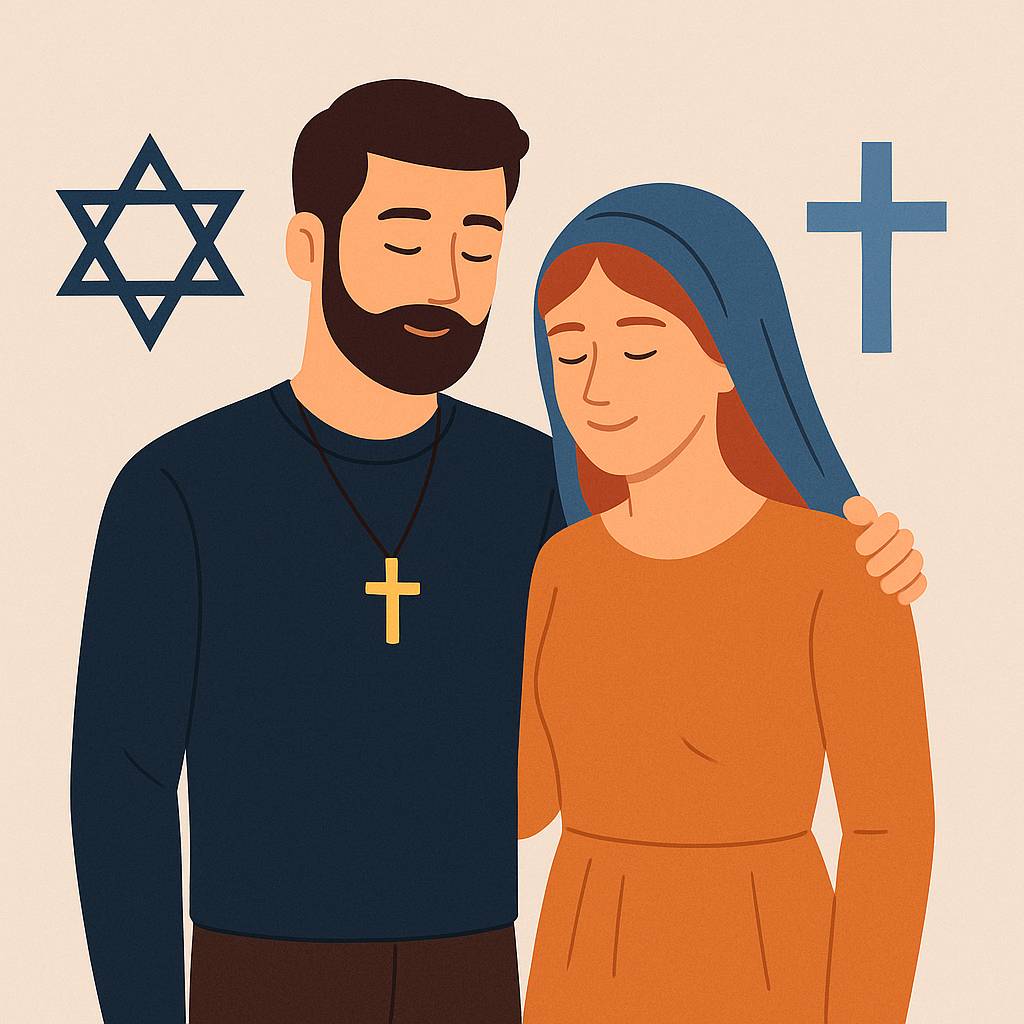
Judaism (halakha and movements)
Halakha (classical Jewish law)
No Jewish religious marriage (qiddushin) with a non-Jew. Orthodox/Conservative rabbis will not officiate. Common sources: Deut 7:3–4; Ezra 9–10; Neh 13; Kiddushin 68b; Shulchan Aruch EH 16.
Children’s status is matrilineal. Child is Jewish if the mother is Jewish (or via recognized conversion).
Result: a Jewish–Christian couple can marry civilly, but the union is not religiously recognized in halakhic frameworks.
Non-Orthodox movements
Reform/Liberal/Progressive: some congregations may officiate or offer blessings, often with conditions (education plans, neutral language). Local variance is high.
Christianity (Scripture and church practice)
Key biblical lines
Unity of faith: “…she is free to marry whom she wishes, only in the Lord.” (1 Cor 7:39)
Warning: “Do not be unequally yoked with unbelievers.” (2 Cor 6:14)
Implication: ideal is shared faith; many churches discourage interfaith marriage or allow it with conditions.
Church practices
Catholic: “mixed marriage” or “disparity of cult” possible with permission/dispensation. Catholic spouse commits to keep the faith and do all in their power to raise children Catholic.
Orthodox: typically expects two baptized Christians; strong limits with a non-baptized spouse.
Protestant/Evangelical: varied; often pastoral caution, with focus on unity and children’s formation.
Practical meaning for a Jewish–Christian couple
1) Religious rite: halakhically no; Christian rite sometimes (with permissions), depending on the church.
2) Civil marriage: most workable and legally recognized; may be followed by separate blessings.
3) Children: matrilineal status in Judaism; Christian desire for Christian formation—a sensitive topic to write down.
4) Home & rites: Shabbat/holy days, Sunday/Christian calendar, kashrut/alcohol, symbols (mezuzah, cross), schedule—create a household pact.
5) Families/communities: anticipate expectations; secure dual guidance (rabbi + priest/pastor) if proceeding.
Three realistic paths
Civil route + written pact on kids, rites, kitchen, feasts, worship; optional two separate blessings.
Christian ceremony with dispensation + civil recognition; understand it won’t be a Jewish halakhic marriage.
Step back if shared faith is non-negotiable for either party or if children/rites plans are incompatible.
Pre-engagement checklist
Children (status/education/rites) ; kitchens (kashrut/alcohol) ; calendar (Shabbat/Sunday/feasts) ; home symbols ; worship places/frequency ; languages/schools ; officiant ; religious recognition ; family reactions. Put it in writing; consult a rabbi and Christian authority plus local law.