"Merry Christmas!"
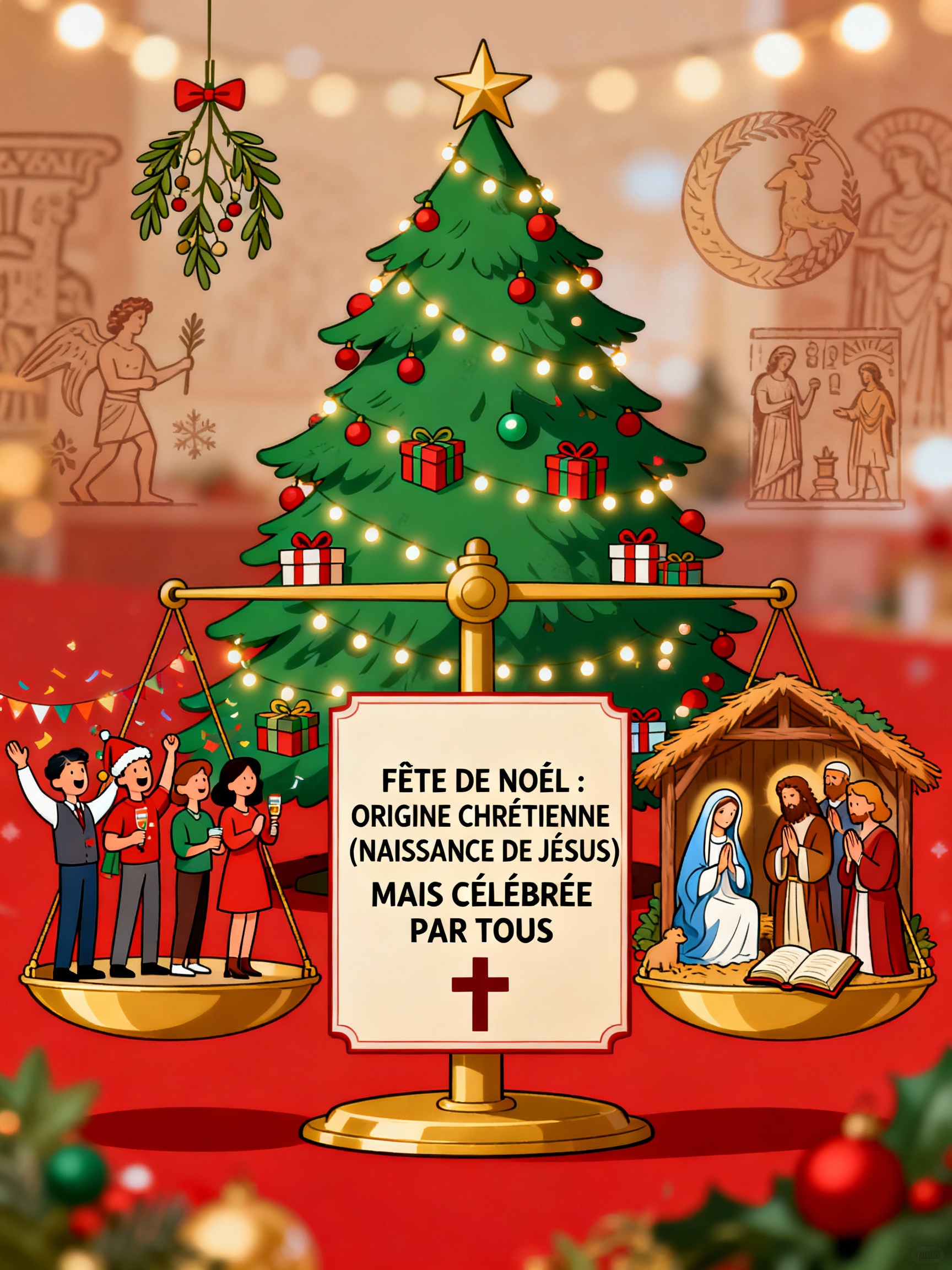
Every year on December 25th, millions of Christians celebrate Jesus' birth. Decorated trees, gifts, family meals, Christmas carols, nativity scenes.
But here's the uncomfortable truth many Christians ignore:
The Bible never mentions Christmas. The first Christians didn't celebrate Christmas. Jesus wasn't born on December 25th.
So, is Christmas a Christian holiday? The answer is neither simple nor comfortable.
What the Bible doesn't say
1. The Bible doesn't give Jesus' birth date
Matthew and Luke recount Jesus' birth. But neither gives a precise date. No "December 25th" or any other date.
Luke 2:8mentions that "Now there were in the same country shepherds living out in the fields, keeping watch over their flock by night."
Shepherds in fields at night. In Israel, this doesn't happen in December (rainy and cold winter), but in spring or fall. Jesus probably wasnotborn on December 25th.
2. The Bible never commands celebrating Jesus' birth
Read the entire New Testament. You'll never find:
- A command to celebrate Christ's birth
- The apostles celebrating Jesus' birthday
- The early churches organizing birthday celebrations
What the Bible commands to celebrate:Christ's death and resurrection(the Lord's Supper, 1 Corinthians 11:23-26).
Not His birth. His death and resurrection. That's where our salvation is found.
3. The first Christians didn't celebrate Christmas
For the first 300 years of Christianity, no church celebrated Christmas. Zero. Christians of the 1st, 2nd and 3rd centuries had never heard of Christmas.
Only in the4th centurydid the Catholic church begin celebrating Christ's birth on December 25th. Not because it was the real date. But for a strategic reason.
The real origin of December 25th
December 25th was already a major holiday in the Roman Empire:the feast of Sol Invictus(the unconquered sun), celebrating the winter solstice and the sun's "rebirth."
Pagan Romans partied on this day. When the Empire became "Christian" under Constantine, the church decided to Christianize this pagan feast by placing Jesus' birth celebration on it.
Evangelization strategy or compromise with paganism?Opinions differ.
Christmas traditions have pagan roots
The Christmas tree: comes from Germanic pagan traditions that decorated trees to honor deities.
Mistletoe and holly: used in pagan Druidic rituals.
Santa Claus: mixture of Saint Nicholas (Christian figure) and Nordic pagan traditions.
Excessive gifts: closer to modern commercialization than anything biblical.
Does this mean celebrating Christmas is sin? Not necessarily. But it meansChristmas is not a biblically commanded holiday.
What the Bible really says about holidays
1. Christian freedom regarding days
Romans 14:5-6- "One person esteems one day above another; another esteems every day alike. Let each be fully convinced in his own mind. He who observes the day, observes it to the Lord; and he who does not observe the day, to the Lord he does not observe it."
Paul clearly says: you're free to consider certain days special, or to consider them all equal.It's a matter of personal conscience, not law.
If you want to celebrate December 25th as a day to honor Christ, you're free. If you don't want to, you're free too.
But don't judge those who make a different choice than you.
2. Warning against human traditions
Colossians 2:8- "Beware lest anyone cheat you through philosophy and empty deceit, according to the tradition of men, according to the basic principles of the world, and not according to Christ."
Traditions aren't bad in themselves. But when theyreplacebiblical truth or becomemandatory, they become dangerous.
If your church teaches that "real Christians must celebrate Christmas" or that "refusing Christmas is rejecting Christ," it's false. The Bible never says that.
3. The true center: Christ
Colossians 2:16-17- "So let no one judge you in food or in drink, or regarding a festival or a new moon or sabbaths, which are a shadow of things to come, but the substance is of Christ."
Paul frees Christians from the obligation to celebrate specific days. What matters isn't theday, it'sChrist.
You can honor Christ on December 25th. You can honor Him on July 15th. You can honor Him every day. The day has no spiritual importance in itself.
Three legitimate Christian positions on Christmas
Position 1: Celebrate Christmas in honor of Christ
"Yes, I know December 25th isn't the real date. Yes, I know the origins are pagan. But I use this day to worship Christ, reflect on the incarnation, and witness to my family. For me, it's a tool for evangelization and worship."
This is legitimateif your motivation is truly Christ and not tradition or social pressure.
Warning: Don't let consumerism, materialism, and pagan traditions dominate. If your Christmas looks more like a commercial holiday than a celebration of Christ, you have a problem.
Position 2: Celebrate Christmas culturally but not spiritually
"I have a family meal on December 25th. I give gifts. But I don't consider it a religious holiday. It's just a cultural family time. I honor Christ all year, not especially on this day."
This is legitimatetoo. You recognize Christmas isn't biblically commanded, but you participate in cultural aspects without attaching spiritual meaning.
Warning: Don't participate in clearly pagan or commercial aspects that dishonor Christ. Keep your conscience clear.
Position 3: Refuse to celebrate Christmas
"I don't celebrate Christmas because it's not biblical, the origins are pagan, and I don't want to mix the sacred and profane. I prefer honoring Christ every day without man-made holidays."
This is legitimateas well. You exercise your freedom not to participate in a non-biblical tradition.
Warning: Don't judge those who celebrate. Don't consider yourself more spiritual than them. Romans 14 forbids this kind of judgment.
What is NOT acceptable
1. Judging other Christians for their choice
Romans 14:3-4- "Let not him who eats despise him who does not eat, and let not him who does not eat judge him who eats; for God has received him. Who are you to judge another's servant?"
If you celebrate Christmas, don't treat those who don't as "legalistic Pharisees."
If you don't celebrate Christmas, don't treat those who do as "Christians compromised with paganism."
Let each follow their conscience before God.
2. Making Christmas a salvation issue
Celebrating or not celebrating Christmas has nothing to do with your salvation. You're not saved by celebrating Christmas. You're not holier by refusing Christmas.
Ephesians 2:8-9- "For by grace you have been saved through faith, and that not of yourselves; it is the gift of God, not of works, lest anyone should boast."
Salvation is by faith in Christ alone. Period.
3. Letting Christmas replace the Gospel
If your church talks more about Christmas than the cross and resurrection, there's a problem.
If your children know Santa Claus' story better than Jesus dying for their sins, there's a problem.
If you spend more time and money on Christmas than God's work the rest of the year, there's a problem.
Christmas must never eclipse the Gospel.
4. Participating in clearly anti-Christ aspects
Some modern aspects of Christmas are clearly incompatible with Christian faith:
The Santa Claus lie: Deliberately lying to your children is never biblical. "Santa sees all, knows all, rewards the good" - you're creating a false god.
Excessive materialism: Going into debt to buy useless gifts contradicts all biblical wisdom on money.
Drunkenness and debauchery: Many "Christmas parties" look more like pagan orgies than Christ celebrations.
If your Christmas includes these things, stop. It's not honoring Christ. It's dishonoring Him.
Practical questions and biblical answers
"Should I have a Christmas tree?"
The tree itself is neither good nor bad. It's a neutral object. If you decorate a tree as family tradition without spiritual meaning, it's not sin.
But if you feel in your conscience it's wrong because of pagan origins, don't do it.Romans 14:23- "Whatever is not from faith is sin."
"Should I say 'Merry Christmas'?"
Yes, you can. It's a cultural greeting. It doesn't mean you approve of everything Christmas has become in society.
But you can also say "Happy Holidays," "God bless you," or simply "Hello." None of these options is more or less spiritual.
"Should I give gifts?"
Giving gifts can be a legitimate act of love.James 1:17says "every good gift and every perfect gift is from above."
But don't go into debt. Don't make consumerism your idol. Don't replace biblical generosity toward the poor with excessive gifts for people who don't need them.
1 John 3:17- "But whoever has this world's goods, and sees his brother in need, and shuts up his heart from him, how does the love of God abide in him?"
"How do I explain Christmas to my children?"
Be honest. Don't lie to them with Santa Claus. Explain:
"Many people celebrate Christmas on December 25th to remember that Jesus was born. We don't know the real date, but that's okay. What matters is that Jesus came to earth to save us. He died on the cross for our sins and He rose again. That's the best news in the world!"
Use this time to teach the incarnation, not to create false traditions.
"My church does a big Christmas show. Should I participate?"
If the show truly exalts Christ and presents the Gospel, participate with joy.
If it's just cultural entertainment without clear biblical message, it's for your conscience to decide.
If it mixes clearly pagan or anti-biblical elements, refuse.
The true message of the incarnation
Whether you celebrate Christmas or not, never miss the miracle of the incarnation:
John 1:14- "And the Word became flesh and dwelt among us, and we beheld His glory, the glory as of the only begotten of the Father, full of grace and truth."
God became man. The Creator entered His creation. The Eternal took human flesh.
Why?
Philippians 2:6-8- "Who, being in the form of God, did not consider it robbery to be equal with God, but made Himself of no reputation, taking the form of a bondservant, and coming in the likeness of men. And being found in appearance as a man, He humbled Himself and became obedient to the point of death, even the death of the cross."
To save us. To die in our place. To pay for our sins.
That's the real message.Not the gifts. Not the tree. Not the traditions. But Christ come to save sinners.
The final message
Christmas is not a biblically commanded holiday. The origins are mixed. The date is false. The traditions are often pagan.
But here's the real question: What will you do with this information?
Option 1: Celebrate Christmas, but do it truly for Christ
If you choose to celebrate, do it with conviction. Center everything on Christ. Teach the Gospel. Reject materialism. Use this time to truly worship.
Don't pretend it's biblical when it's not. But use it as an opportunity to honor Christ and witness.
Option 2: Don't celebrate Christmas, but don't make it a doctrine
If you choose not to celebrate, do it with conviction. But don't judge others. Don't believe you're superior. Don't make your refusal a source of pride.
And especially, make sure you honor Christevery day, not just refuse a particular day.
What really counts
Romans 14:7-8- "For none of us lives to himself, and no one dies to himself. For if we live, we live to the Lord; and if we die, we die to the Lord. Therefore, whether we live or die, we are the Lord's."
December 25th or July 15th, you belong to Christ. Live for Him. Every day. In all your decisions. Including this one.
And remember:salvation is not in a date. It's in a person. Jesus Christ.
Whether you celebrate His birth on December 25th or not, what matters is that you know Him personally as your Savior and Lord.
That's the real celebration that counts.
Foundational Bible verses
Romans 14:5-6- "One person esteems one day above another; another esteems every day alike. Let each be fully convinced in his own mind. He who observes the day, observes it to the Lord."
Colossians 2:16-17- "So let no one judge you in food or in drink, or regarding a festival or a new moon or sabbaths, which are a shadow of things to come, but the substance is of Christ."
John 1:14- "And the Word became flesh and dwelt among us, and we beheld His glory, the glory as of the only begotten of the Father, full of grace and truth."
Philippians 2:6-8- "Who, being in the form of God, did not consider it robbery to be equal with God, but made Himself of no reputation, taking the form of a bondservant, and coming in the likeness of men."
Romans 14:23- "Whatever is not from faith is sin."