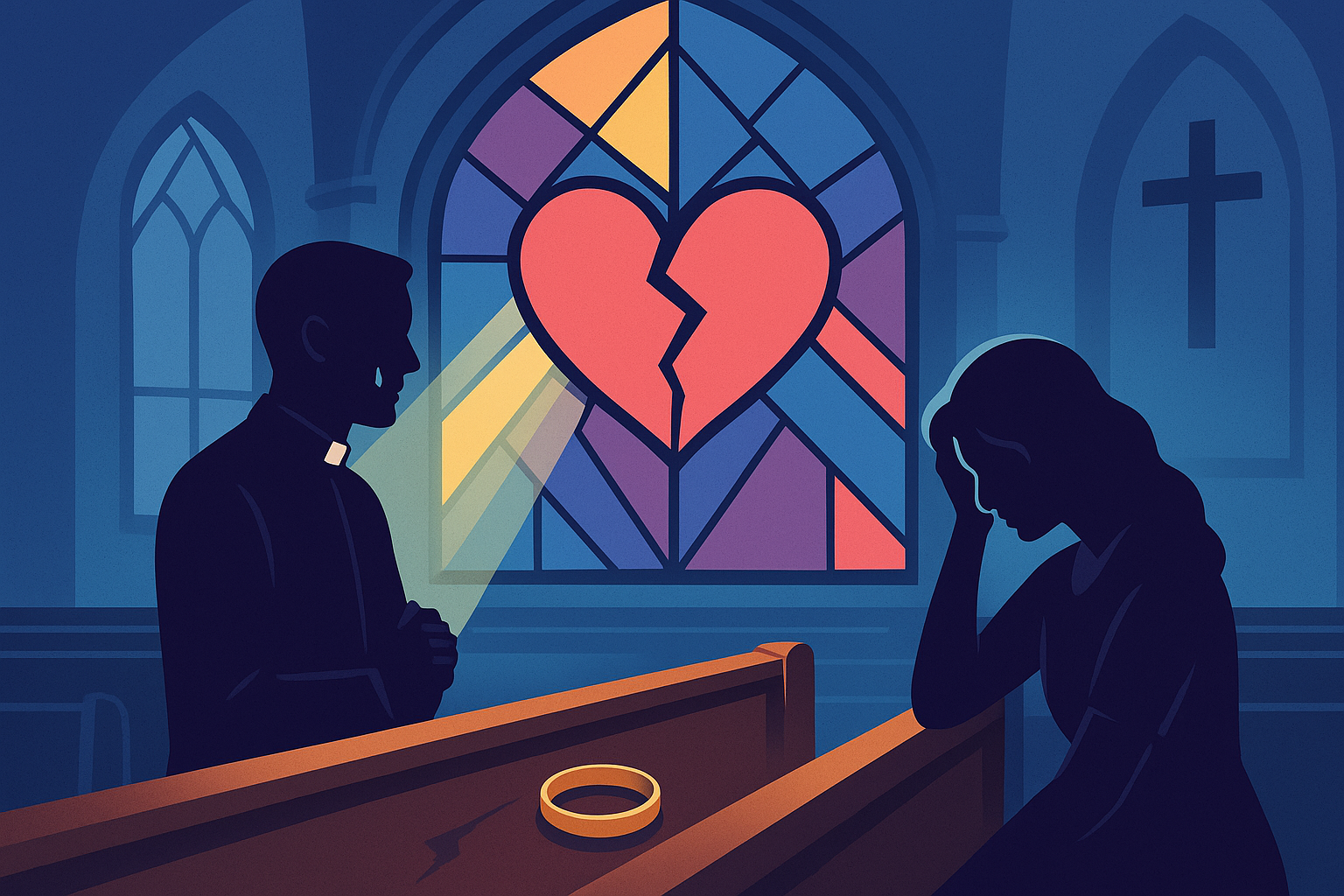
Infidelity Doesn't Respect Church Walls
Let's talk about what no one dares to address on Sunday morning. Infidelity exists in the church. Christian couples who praise God together on weekends but live in lies during the week. Baptized spouses who betray their vows. Blessed marriages that break in adultery. And meanwhile, the church pretends it only happens to "others."
Let's stop the hypocrisy. Infidelity strikes Christian couples just as much as others. Perhaps even more painfully, because it breaks not only the marital covenant but also spiritual trust. How can the man or woman who prays with you, who sings hymns at your side, who speaks Jesus' name, betray you like this?
This question haunts thousands of Christian couples right now. And they suffer in silence because they believe their pain has no place in the church. That their situation is "too dirty" to be mentioned. Today, we break this silence with biblical truth. Not to condemn, but to illuminate and restore.
What The Bible Says Bluntly About Adultery
The Bible doesn't mince words about infidelity. Exodus 20:14 is clear and direct: "You shall not commit adultery." It's one of the Ten Commandments. Not a suggestion. Not a recommendation. An absolute command from God to protect the sanctity of marriage.
Jesus goes even further in Matthew 5:27-28: "You have heard that it was said to those of old, 'You shall not commit adultery.' But I say to you that whoever looks at a woman to lust for her has already committed adultery with her in his heart." Infidelity doesn't start in bed. It starts in the heart, in thoughts, in lingering looks, in conversations that become too intimate.
Why does God take adultery so seriously? Because marriage is the earthly image of His covenant with His people. Ephesians 5:25 says: "Husbands, love your wives, just as Christ also loved the church." When you betray your spouse, you profane this sacred image. You break something God has declared holy.
Hebrews 13:4 warns unambiguously: "Marriage is honorable among all, and the bed undefiled; but fornicators and adulterers God will judge." God doesn't look away. He doesn't minimize. Infidelity has real and serious spiritual consequences.
The Devastating Consequences Of Infidelity
Infidelity doesn't just destroy a couple. It devastates everything in its path. Trust is pulverized. Intimacy becomes impossible. Every word is suspect. Every delay at work triggers panic. The betrayed spouse lives in a daily hell of doubt, pain, and mental images that torture them.
Children observe and absorb. They see Mom or Dad cry. They feel the tension. They hear the nighttime arguments. And their vision of marriage, love, faith, cracks. A parent's infidelity marks children for years, sometimes forever.
The Christian community suffers too. The testimony is destroyed. "How can they talk about God's love when they can't even stay faithful to each other?" Non-believers point fingers. Young Christians waver in their faith. The body of Christ is wounded.
And the unfaithful one themselves? They live in devouring guilt, even if they try to hide it. Proverbs 6:32-33 declares: "Whoever commits adultery with a woman lacks understanding; he who does so destroys his own soul. Wounds and dishonor he will get, and his reproach will not be wiped away." Infidelity leaves indelible scars.
Does God Forgive Infidelity?
Here's the question burning in the heart of the Christian couple broken by adultery: can God forgive this? Can our marriage survive this betrayal?
The biblical answer is: yes, God forgives. But this forgiveness is never cheap. It requires authentic, deep, heart-wrenching repentance. Not excuses. Not justifications. A true acknowledgment of sin before God and before the betrayed spouse.
1 John 1:9 promises: "If we confess our sins, He is faithful and just to forgive us our sins and to cleanse us from all unrighteousness." God never rejects the truly repentant heart. The story of David and Bathsheba proves it. David committed adultery, then murder to cover his sin. It was horrible. Humanly unforgivable. And yet, when David truly repented in Psalm 51, God forgave him.
But beware: God's forgiveness doesn't automatically erase earthly consequences. David was forgiven, but his child died. His family experienced years of chaos. Divine forgiveness restores the relationship with God, but rebuilding marital trust requires time, effort, total transparency.
Is Restoration Possible?
Jesus gives an exception in Matthew 19:9: "And I say to you, whoever divorces his wife, except for sexual immorality, and marries another, commits adultery." Infidelity biblically gives the right to divorce. You're not obligated to stay. God understands the depth of this wound.
But notice: Jesus says it's permitted, not mandatory. Divorce is an option given to the betrayed spouse, not an obligation. Some couples choose to fight for their marriage despite adultery. And with God, restoration is possible.
This restoration requires radical commitment from both sides. The unfaithful must accept total transparency. Complete access to phones, emails, social media, schedules. Immediate and definitive end of any relationship with the person involved. Job change if necessary. Mandatory Christian counseling. Nothing less suffices.
The betrayed spouse must consciously choose to forgive while knowing that healing will take years. Colossians 3:13 encourages: "Bearing with one another, and forgiving one another, if anyone has a complaint against another; even as Christ forgave you, so you also must do."
This forgiveness isn't a feeling. It's a daily decision not to use the past as a weapon. To choose healing rather than revenge. To allow God to transform this tragedy into a testimony of His restorative power.
How The Church Should Respond
The church has often failed in its response to infidelity. Either it condemns without mercy, chasing away broken couples who desperately need community. Or it minimizes sin, preaching a false gospel of tolerance that heals no one.
The true biblical response holds two truths in tension: sin is serious AND the sinner can be restored. Galatians 6:1 instructs: "Brethren, if a man is overtaken in any trespass, you who are spiritual restore such a one in a spirit of gentleness, considering yourself lest you also be tempted."
The church must create a safe space where couples can confess their struggles before infidelity occurs. Where a husband can say "I'm attracted to a colleague and I'm afraid" without being judged but helped. Where a woman can admit "I feel abandoned and vulnerable" without being condemned but supported.
When infidelity occurs, the church must walk alongside the couple in the long process of restoration. Not by ignoring sin. Not by forcing quick reconciliation. But by holding the unfaithful accountable while offering grace. By weeping with the betrayed spouse while pointing to hope in God.
The Challenge To Protect Your Marriage
If you haven't been touched by infidelity yet, don't think you're immune. 1 Corinthians 10:12 warns: "Therefore let him who thinks he stands take heed lest he fall." Infidelity begins with small compromises you easily justify.
This week, have this difficult conversation with your spouse: "Let's put protective barriers in our marriage." Not because you don't trust each other, but because you take the sanctity of your union seriously.
Establish clear rules: no one-on-one lunches with opposite-sex colleagues. Total transparency on passwords. Open conversations about temptations. Daily prayer together. Continuous investment in your emotional and physical intimacy.
And if infidelity has already struck your couple? Know this: God hasn't abandoned your marriage. Restoration is painful, long, difficult. But it's possible. Couples have lived it. They testify today of a deeper intimacy than before the crisis because they learned to rebuild on the Rock that is Christ.
Infidelity in the church exists. But God's restorative power exists too. The question is: will you choose the difficult path of healing or the easy path of abandonment?