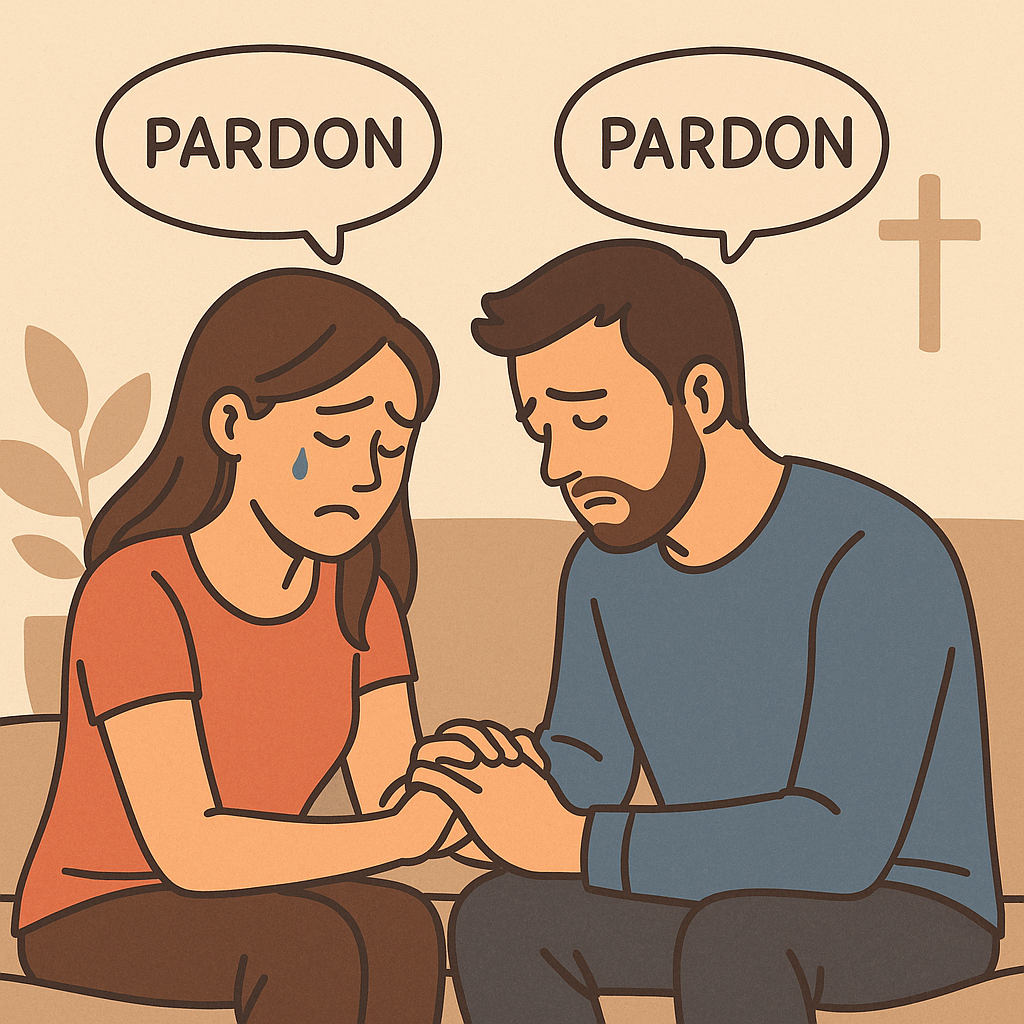
You Hurt The Person You Love
The words came out. Those words you can't take back. Those words that pierced your spouse's heart like knives. You saw the pain in their eyes. The shock. The betrayal. The deep wound.
And now, you want to fix it. You want to say "I'm sorry". You want everything to go back to how it was. But you don't know how. Or worse, you think simply saying "sorry" will be enough.
No. It's not enough.
Because superficial apologies don't heal deep wounds. Automatic "sorries" don't restore broken trust. "Forgive me's" without sincerity don't rebuild what you destroyed with your words.
Proverbs 18:21 declares: "The tongue has the power of life and death." Your tongue chose death. Your words killed something in your marriage. Now, you must use your words to bring life back. But not just any way.
James 5:16 says: "Therefore confess your sins to each other and pray for each other so that you may be healed." Note: "so that you may be healed". True confession leads to healing. False apologies lead to more wounds.
Today, you'll learn how to truly ask forgiveness. With sincerity. With honesty. With humility. Not manipulation techniques. Biblical truth about repentance and reconciliation in marriage.
The False Apologies That Hurt Even More
Before learning to apologize well, you must stop apologizing badly. These phrases you think are apologies but are actually disguised insults.
False Apology 1: "I'm sorry IF I hurt you"
No. You know perfectly well you hurt them. You saw the pain. "IF" implies you're not sure. That maybe your spouse is too sensitive. That maybe the problem is their reaction, not your words.
This is a conditional apology. And conditional apologies are NOT apologies. They're disguised accusations.
The real apology says: "I hurt you. I know it. I'm sorry."
False Apology 2: "I'm sorry, BUT you provoked me"
The word "BUT" cancels everything before it. "I'm sorry BUT" really means "It's not really my fault". You just shifted responsibility to your spouse.
Yes, maybe they provoked you. Maybe she said something first. But YOU are responsible for YOUR words. Nobody forced you to say what you said.
Proverbs 15:1 says: "A gentle answer turns away wrath, but a harsh word stirs up anger." You had the choice to respond gently. You chose the harsh word. That's YOUR responsibility.
The real apology contains no "but". Period.
False Apology 3: "Sorry you took it the wrong way"
Again, you're shifting blame. The problem isn't what you said. It's how they received it. They "took it wrong". Their perception is the problem, not your words.
No. The problem is WHAT YOU SAID. Own it.
The real apology says: "I deeply regret what I said. It was hurtful and unfair."
False Apology 4: "Let's just forget it and move on"
You want to sweep everything under the rug. Minimize. Ignore the depth of the wound. Force a quick forgiveness so YOU feel better.
But your spouse needs time. To see your sincerity. To believe you truly understand the pain you caused.
Ephesians 4:26 says: "In your anger do not sin: Do not let the sun go down while you are still angry." Yes, resolve quickly. But resolve TRULY. Not superficially.
False Apology 5: "I said sorry, what more do you want?"
Your impatient tone. Your irritation. Your attitude that says "I did my part, now forgive me NOW."
You're turning your apology into a demand. You're not really sorry. You just want this uncomfortable situation to end.
True repentance is patient. It understands that healing takes time. It doesn't force forgiveness.
Colossians 3:13 says: "Bear with each other and forgive one another if any of you has a grievance against someone." Bear with each other. It takes time.
False Apology 6: "You know I didn't really mean it"
If you didn't mean it, why did you say it? Words don't come from nowhere. They reveal what's in your heart.
Matthew 12:34 says: "For the mouth speaks what the heart is full of." Your words revealed something in your heart. Something ugly. Bitter. Hurtful.
Instead of denying, acknowledge: "I said horrible things. And I need to examine my heart to understand why those words were there."
What A REAL Biblical Apology Is
A real biblical apology isn't just words. It's complete repentance that leads to restoration. Here are the absolutely essential elements.
Element 1: Specifically Acknowledge Your Fault
Don't be vague. "I'm sorry about yesterday" isn't enough. Precisely name what you did.
"I apologize for calling you [hurtful word]. That was cruel and totally unfair. You don't deserve to be treated like that."
"I deeply regret yelling at you in front of the children. I humiliated you and set a terrible example for our kids."
"I'm sorry I said you're like your mother. I know how hurtful that is to you and I used it intentionally to hurt you."
Specific. Precise. Honest about WHAT you did.
James 5:16 says: "Therefore confess your sins to each other." Confess. Not "vaguely allude". CONFESS specifically.
Element 2: Acknowledge The Impact Of Your Words
Don't just acknowledge WHAT you said. Acknowledge the EFFECT of your words.
"I realize my words deeply hurt you. I saw the pain in your eyes. I broke your trust in me."
"I understand that when I said that, you felt rejected and unloved. I made the person I love most doubt my love."
"My words humiliated you in front of your family. I created a situation where you probably feel embarrassed and betrayed."
Show you understand the PAIN you caused. Not just the act. The consequence.
Proverbs 12:18 says: "The words of the reckless pierce like swords." Acknowledge that your tongue was a sword. That you wounded. Deeply.
Element 3: Take Full Responsibility
Zero excuses. Zero justification. Zero "buts". You assume 100% responsibility for YOUR words.
"This is entirely my fault. I can't blame my stress, my fatigue, or anything else. I chose those words and I'm responsible for them."
"There's no excuse for what I said. Even if I was angry, I chose to respond with cruelty instead of self-control."
"I'm not going to try to justify my words. They were unjustifiable. Period."
Romans 14:12 says: "So then, each of us will give an account of ourselves to God." YOU will give account for YOUR words. Own them now.
Element 4: Express Authentic Remorse
Not just "I'm sorry". Express the depth of your regret. Let your spouse SEE you're truly sorry.
"My heart is broken for doing this to you. You're the person I love most and I treated you like an enemy. I'm so, so sorry."
"I hate myself for saying that. Those words haunt me. I'd do anything to take them back but I can't. I deeply regret it."
"If I could go back in time and keep silent, I'd do it in a second. I'm devastated by the pain I caused you."
2 Corinthians 7:10 says: "Godly sorrow brings repentance that leads to salvation and leaves no regret, but worldly sorrow brings death."
Godly sorrow is deep. Authentic. It changes the heart.
Element 5: Ask For Forgiveness (Without Demanding It)
After acknowledging, owning, and expressing your remorse, THEN you can ask forgiveness. Humbly. Without demand.
"I don't deserve your forgiveness, but I humbly ask for it. Can you forgive me?"
"I know my words created a deep wound. I understand if you need time. But when you're ready, I pray you can forgive me."
"I hurt you and I regret it. I ask your forgiveness, knowing it's not for me to decide when you'll forgive."
Note: You ASK. You don't demand. You don't force. You humbly ask and wait.
Luke 17:3-4 says: "If your brother or sister sins against you, rebuke them; and if they repent, forgive them. Even if they sin against you seven times in a day and seven times come back to you saying 'I repent,' you must forgive them."
Repentance precedes forgiveness. But repentance doesn't demand immediate forgiveness.
Element 6: Propose Concrete Change
Words without actions are empty. You must show how you're going to CHANGE.
"I'm going to work on my temper. I'll take a step back before responding when I'm angry."
"I'm going to see a counselor to understand why I become so mean when we argue."
"I commit to never using that word against you again. Never. And I give you permission to remind me if I do."
James 2:17 says: "Faith by itself, if it is not accompanied by action, is dead." Likewise, repentance without action is dead.
Show you're going to CHANGE. Not just that you regret.
Element 7: Give Time And Space
After presenting your complete apology, give your spouse what they need: time, space, or conversation.
"I understand if you need time to process all this. I'm here when you're ready to talk."
"You don't have to forgive me right away. I'll show you through my actions that I'm sincere."
"If you want to talk more about it, I'm listening. If you prefer to be alone for now, I respect that."
Ecclesiastes 3:7 says: "There is a time to be silent and a time to speak." After speaking (your apology), it may be time to be silent and wait.
Practical Steps To Present Your Apology
Now that you know WHAT to say, here's HOW to do it concretely.
Step 1: Prepare Yourself Spiritually
Before talking to your spouse, talk to God.
Confess your sin to God first. Ask His forgiveness. Ask for wisdom to know what to say.
Psalm 51:10 prays: "Create in me a pure heart, O God, and renew a steadfast spirit within me."
Pray this prayer. Ask God to purify your heart before approaching your spouse.
Step 2: Choose The Right Time And Place
Don't present your apology:
When your spouse is busy or distracted
In front of the children (unless the hurt happened in front of them)
By text or message (for serious wounds)
When you're still angry or defensive
Choose a calm time. Private. Where you can have your spouse's full attention.
Ask: "Can you give me a few minutes? I need to talk to you about what I said yesterday."
Step 3: Look Your Spouse In The Eyes
No phone between you. No distractions. Look them in the eyes.
Eyes reveal sincerity. Your spouse must SEE your remorse. Not just hear it.
Proverbs 27:19 says: "As water reflects the face, so one's life reflects the heart."
Your face must show what your heart feels.
Step 4: Use The 7-Element Structure
Follow exactly the 7 elements of a true apology:
Specifically acknowledge your fault
Acknowledge the impact
Take full responsibility
Express authentic remorse
Ask forgiveness (without demanding)
Propose concrete change
Give time and space
Don't skip any element. They're all essential.
Step 5: Listen To The Response Without Defending Yourself
Your spouse may:
- Cry
- Express more pain
- Tell you other things you've done
- Need time before forgiving
Listen. Do NOT defend yourself. Do NOT counter-attack. Even if it's hard to hear.
James 1:19 says: "Everyone should be quick to listen, slow to speak and slow to become angry."
Be QUICK to listen. SLOW to speak. SLOW to defend yourself.
Step 6: Accept The Consequences
Your spouse may:
- Not forgive you immediately
- Need space
- Have lost trust in you
- Be distant for a while
Accept these consequences. You created them with your words. You must now bear them.
Galatians 6:7 warns: "Do not be deceived: God cannot be mocked. A man reaps what he sows."
You sowed hurtful words. You're now reaping pain and distance. Accept it with humility.
Step 7: Prove Your Change Through Actions
In the days, weeks and months following, SHOW you've changed.
If you said you'd control your temper, control it. If you said you wouldn't yell anymore, don't yell. If you said you'd see a counselor, make an appointment.
Matthew 3:8 says: "Produce fruit in keeping with repentance."
The fruit. The actions. Not just promises.
When Your Spouse Won't Forgive
You presented sincere apologies. Complete. Humble. But your spouse still won't forgive. What to do?
Reality 1: You Can't Force Forgiveness
Forgiveness is a choice only your spouse can make. You can't force it. Manipulate it. Demand it.
You did your part (sincere apologies). Now, the ball is in their court.
Romans 12:18 says: "If it is possible, as far as it depends on you, live at peace with everyone."
"As far as it depends on you". You did what depended on you. The rest depends on them.
Reality 2: Some Wounds Take Time
Maybe your words touched a very deep wound. A childhood trauma. A deep insecurity. A rooted fear.
Your spouse may WANT to forgive but need time to process the pain.
Be patient. Continue showing through your actions that you've changed.
Proverbs 14:29 says: "Whoever is patient has great understanding."
Reality 3: Your Spouse May Need Help
If forgiveness doesn't come after a reasonable time, gently suggest:
"I understand my words deeply hurt you. Maybe talking with a counselor could help you process this pain. I'd willingly come with you if you'd like."
Proverbs 11:14 says: "Victory is won through many advisers."
Sometimes, a neutral third party can help healing.
Reality 4: You Must Continue Living With Integrity
Even if forgiveness is delayed, continue living with integrity. Don't become bitter. Don't restart old patterns.
Show through a transformed life that your repentance was real. Not just words to get out of an uncomfortable situation.
Philippians 1:27 says: "Whatever happens, conduct yourselves in a manner worthy of the gospel of Christ."
Conduct yourself worthily. Whether forgiveness comes or not.
If You're The One Who Must Forgive
Maybe you're reading this and YOU'RE the one who was hurt. Your spouse apologized. Maybe even sincere apologies. But you're struggling to forgive.
Truth 1: Forgiving Is A Command
It's not optional. God doesn't say "forgive if you feel like it". He commands forgiveness.
Ephesians 4:32 commands: "Be kind and compassionate to one another, forgiving each other, just as in Christ God forgave you."
Just as God forgave you. You who hurt God with your sins. You who deserve eternal death. God forgave you in Christ.
Can you refuse to forgive your spouse?
Truth 2: Forgiving Doesn't Mean Pretending
Forgiving doesn't mean:
It doesn't hurt anymore
You must forget instantly
Trust is restored immediately
You must act like nothing happened
Forgiving means:
You choose to no longer hold this offense against your spouse
You release your spouse from your judgment
You trust God to handle justice
You open the door to reconciliation
Mark 11:25 says: "And when you stand praying, if you hold anything against anyone, forgive them, so that your Father in heaven may forgive you your sins."
Truth 3: Refusing To Forgive Poisons You
Bitterness is a slow poison. It destroys the one carrying it much more than the one who caused it.
Hebrews 12:15 warns: "See to it that no one falls short of the grace of God and that no bitter root grows up to cause trouble and defile many."
Your bitterness will infect your marriage, your children, your entire life.
Forgive. Not to free your spouse. To free YOURSELF.
Truth 4: God Can Heal The Wound
You think the pain will never go away. That you'll never be able to look at your spouse the same way.
But God is the Healer. He can heal even the deepest wounds.
Psalm 147:3 promises: "He heals the brokenhearted and binds up their wounds."
Trust God to heal your broken heart. Choose forgiveness. Let God do the rest.
Restoration Is Possible
Here's the final truth you must believe: your marriage can be restored. Hurtful words can be healed. Trust can be rebuilt. Love can be renewed.
BUT only if:
The one who hurt gives true apologies (not false ones)
The one who's hurt chooses forgiveness (even if it's difficult)
Both commit to rebuilding with God's help
Joel 2:25 promises: "I will repay you for the years the locusts have eaten."
God can restore the years devoured by hurtful words. By arguments. By wounds. He can restore EVERYTHING.
2 Corinthians 5:17 declares: "Therefore, if anyone is in Christ, the new creation has come: The old has gone, the new is here!"
All things NEW. Even your wounded marriage. Even your broken relationship.
Lamentations 3:22-23 reminds: "Because of the LORD's great love we are not consumed, for his compassions never fail. They are new every morning."
Every morning. A new chance. A new grace. A new opportunity to choose love instead of bitterness.
You hurt your spouse with your words. Now, heal them with your actions. Ask forgiveness sincerely. Change truly. Rebuild patiently.
Your marriage can survive this storm. It can even come out stronger. But only if you choose humility, authentic repentance, and liberating forgiveness.
Choose well. Your marriage depends on it.