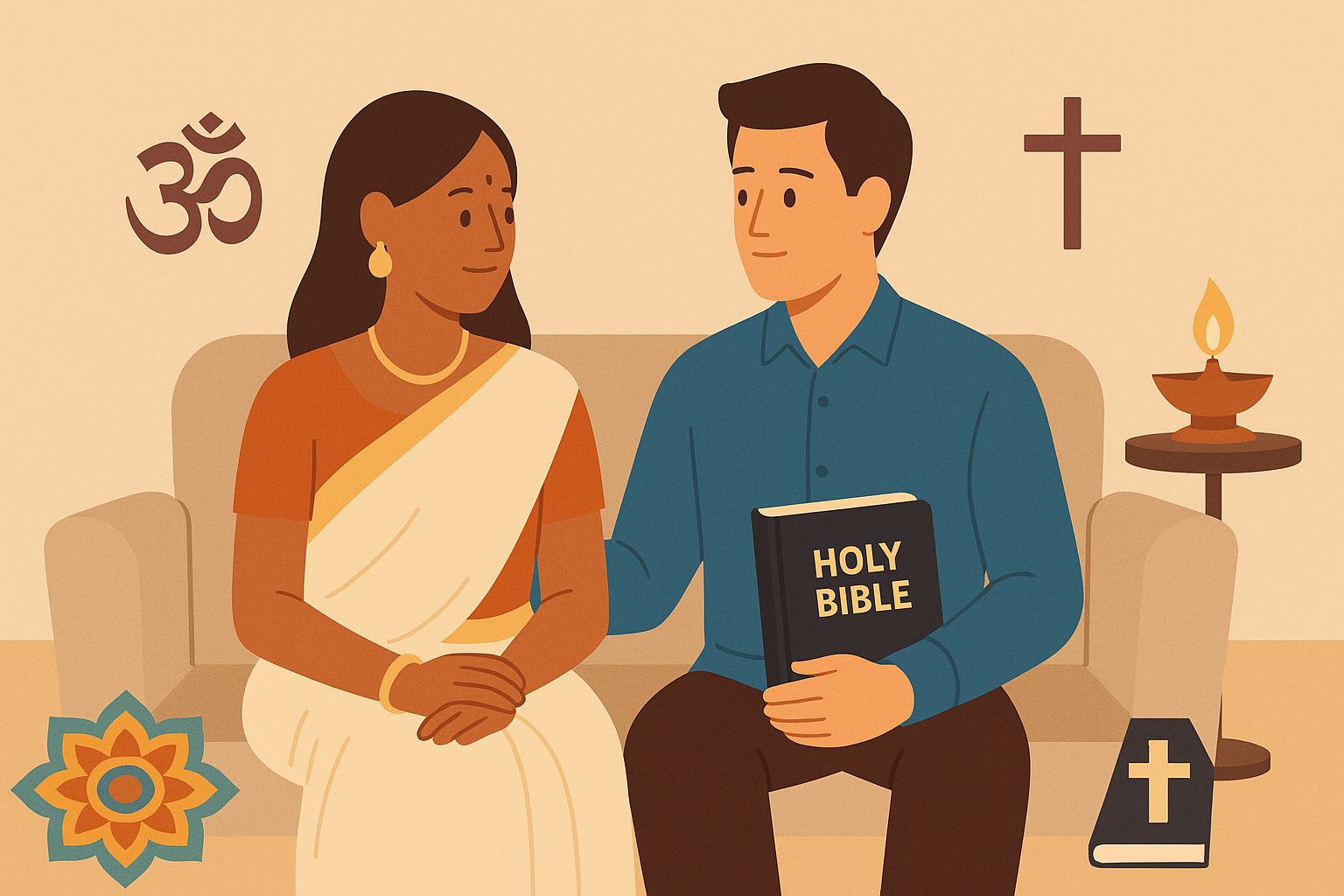
What the traditions say, plainly
Hindu side (realistic overview)
Hinduism has no single central magisterium. Practice depends on school, family, temple, and local custom. In reality:
Many families/temples prefer same-faith marriage.
Some will permit a wedding with a non-Hindu if certain rites are performed (e.g., a saṁskāra, commitments to household deities/family customs).
Others choose a civil ceremony (or a mixed solution) followed by a tailored blessing.
Bottom line: possible in some contexts, but highly conditional on family, priest (purohit), temple rules, and national law. Verify locally.
Biblical/Christian side (clear lines)
The New Testament urges unity of faith in marriage:
“…she is free to be married to whom she wishes, only in the Lord.” (1 Corinthians 7:39, ESV)
“Do not be unequally yoked with unbelievers…” (2 Corinthians 6:14, ESV)
OT warning against unions that lead hearts away (Deuteronomy 7:3–4).
Thus many churches discourage or conditionally allow interfaith weddings (dispensations, preparation, commitments about children’s formation). Some will not celebrate a religious rite without shared faith.
Practical implications
Faith & worship: puja/prayer, temple/church, home icons/idols, weekly rhythm (Sunday/Friday/Saturday), fasts, pilgrimages/feasts.
Children: rites (baptism/namkaran), catechesis, names, feast calendar, religious identity.
Diet/ethics: vegetarian rules/halal/alcohol, food offerings, ritual purity.
Extended families: expectations and boundaries.
Ceremony: will the temple accept it? will the church grant a dispensation? Do you need a civil marriage?
Law: country’s interfaith-marriage law and recognition of rites.
Three workable paths (to discern)
1) Civil wedding + separate blessings (clear written plan for children).
2) Adapted Hindu ceremony + church dispensation (rare, requires strict terms).
3) No religious rite on one/both sides — or no marriage if shared faith is a non-negotiable.
Write a clarity pact before engagement
Put in writing: children’s religious formation; worship places/frequency; feast calendar; kitchen rules/abstinences; home ritual objects; giving/charity plan; conflict-resolution route (pastor/priest mediator). Without a written pact, love erodes in foundational fights.
Word of wisdom
Hindu practice may allow a path locally but expects respect for rites and family.
Scripture calls to marry in the Lord; many churches will not endorse interfaith marriage without strong conditions.
If the path opens, walk with integrity, truth, and respect. If it closes, step back with dignity: better a hard truth than a confused union.