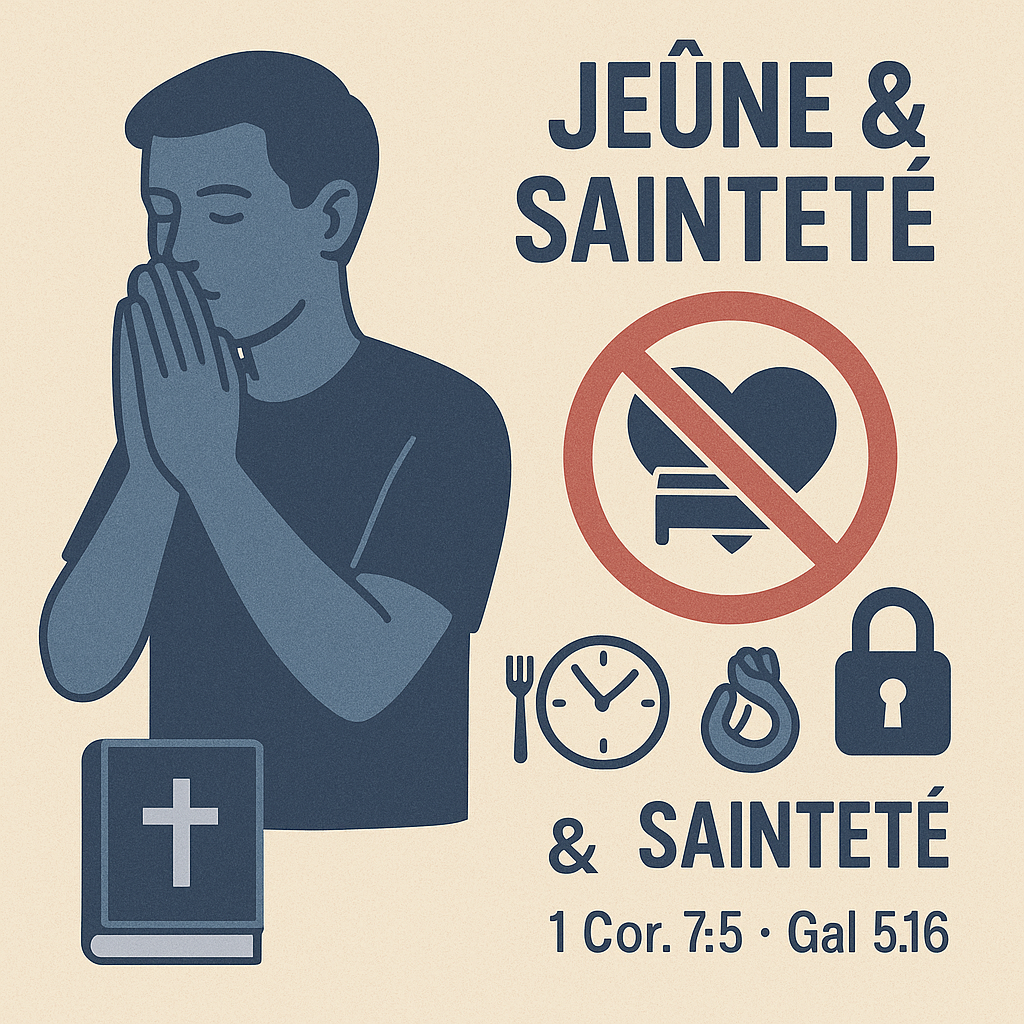
The Direct Question
You're fasting. You're seeking God. You're praying intensely. And you're wondering: "Can I have sexual relations with my spouse during this period?"
Some say yes. Others say no. Some think fasting requires total abstinence, including sexual. Others think that's legalism.
Here's the truth: The Bible answers this question DIRECTLY. Not vaguely. Not indirectly. DIRECTLY.
1 Corinthians 7:5 says: "Do not deprive each other except perhaps by mutual consent and for a time, so that you may devote yourselves to prayer. Then come together again so that Satan will not tempt you because of your lack of self-control."
This verse settles the question. Completely. Definitively.
Today, you'll understand exactly what the Bible teaches about fasting and sexual relations. Without religious additions. Without human traditions. Just God's Word.
What The Bible Says Explicitly
The Clear Principle: 1 Corinthians 7:5
Let's read this key verse carefully: "Do not deprive each other except perhaps by mutual consent and for a time, so that you may devote yourselves to prayer. Then come together again so that Satan will not tempt you because of your lack of self-control."
This verse contains FIVE essential elements:
1. "Do not deprive each other"
The general rule in Christian marriage: DO NOT deprive each other sexually. Sexual intimacy is the NORM in marriage, not the exception.
2. "Except perhaps by mutual consent"
Sexual abstinence is only permitted if BOTH spouses agree. Never a unilateral decision. BOTH must consent.
3. "For a time"
Abstinence is only TEMPORARY. Not permanent. Not indefinite. FOR A TIME. A defined, limited period.
4. "So that you may devote yourselves to prayer"
The ONLY valid biblical reason for sexual abstinence in marriage: to devote yourself intensively to prayer. Not work. Not fatigue. Not children. PRAYER.
5. "Then come together again"
After this period, RESUME sexual relations. This is not optional. It's a command. COME TOGETHER again.
6. "So that Satan will not tempt you"
Why resume quickly? Because prolonged abstinence creates vulnerability to TEMPTATION. Satan particularly attacks in these moments.
The Direct Answer
So, can a Christian who fasts have sexual relations?
YES, absolutely.
EXCEPT if:
- Both he AND his spouse agree to abstain
- For a DEFINED and SHORT period
- With the specific purpose of devoting themselves intensely to PRAYER
- With the commitment to resume afterward
If these four conditions are NOT met, you should NOT abstain sexually during your fast.
Biblical Principles About Fasting
But let's better understand what biblical fasting is and how it relates to sexuality.
Biblical Fasting Concerns FOOD
Matthew 6:16-18 says: "When you fast, do not look somber as the hypocrites do, for they disfigure their faces to show others they are fasting... But when you fast, put oil on your head and wash your face, so that it will not be obvious to others that you are fasting, but only to your Father, who is unseen."
Biblical fasting = abstaining from FOOD. Not sex. Not television. Not social media. These things can accompany fasting, but they are NOT its definition.
Fasting = not eating. Period.
Fasting Does NOT Require Sexual Abstinence
Nowhere in the Old or New Testament do you find instruction that fasting must include sexual abstinence.
Yes, 1 Corinthians 7:5 mentions abstaining "to devote yourselves to prayer". And often, intensive prayer accompanies fasting. But it's NOT an automatic requirement.
You can fast from food AND have sexual relations with your spouse. The Bible doesn't forbid it anywhere.
Fasting Is Between You And God
Matthew 6:17-18 insists: "But when you fast... so that it will not be obvious to others that you are fasting, but only to your Father, who is unseen."
Your fast is a matter between YOU and GOD. Not between you and religious rules. Not between you and church traditions. You and God.
If God calls you to a time of sexual abstinence during your fast, He'll make it clear to BOTH spouses. Not just you.
When Sexual Abstinence Is Appropriate
Now, in what situations is sexual abstinence during fasting appropriate according to 1 Corinthians 7:5?
Situation 1: Intense Short-Term Fast
You and your spouse decide together to fast and pray intensely for 3 days for a critical situation:
- Major life decision
- Serious family crisis
- Urgent spiritual direction
- Intense spiritual warfare
In this case, you might BOTH decide to abstain sexually to devote yourselves totally to prayer.
Conditions:
- Clear mutual agreement
- Defined duration (3 days, 7 days maximum)
- Specific prayer purpose
- Commitment to resume after
Situation 2: Couple's Spiritual Retreat
You participate in a couple's retreat focused on prayer and fasting during a weekend.
You might decide together to abstain during these 2-3 days to focus on God.
But careful: Even in this case, abstinence is NOT mandatory. You can fast, pray intensely, AND have sexual relations. The Bible doesn't forbid it.
Situation 3: Extended Fast With Moments Of Abstinence
You fast 21 days or 40 days. Must you abstain sexually the entire time?
NO.
1 Corinthians 7:5 says "for a TIME". Not "for weeks". An extended fast does NOT justify prolonged sexual abstinence.
You might decide on certain specific days or moments of abstinence (for example, days of intensive prayer), but not the entire duration of the fast.
When Abstinence Is INAPPROPRIATE
Situation 1: Unilateral Decision
You decide to fast and announce to your spouse: "I'm fasting so no sex during this time."
WRONG. This is biblically incorrect.
1 Corinthians 7:5 says "by mutual CONSENT". Your spouse must CONSENT. If he/she doesn't consent, you do NOT have the biblical right to refuse intimacy.
1 Corinthians 7:3-4 says: "The husband should fulfill his marital duty to his wife, and likewise the wife to her husband. The wife does not have authority over her own body but yields it to her husband. In the same way, the husband does not have authority over his own body but yields it to his wife."
Your body is NOT yours alone when you're married. It also belongs to your spouse. You cannot unilaterally decide to deprive them.
Situation 2: Indefinite Abstinence
"I'm fasting until God answers me, so no sex until I get my answer."
WRONG.
1 Corinthians 7:5 says "for a TIME". A DEFINED time. Not "until something happens".
You must define a precise duration. "3 days." "One week." Not "until..."
Situation 3: Fasting As An Excuse
You don't feel like intimacy with your spouse, so you "fast" to have a spiritual excuse to refuse.
This is religious manipulation. And it's sin.
You're using fasting as a weapon against your spouse. As a means of control. As spiritual justification for not fulfilling your marital duties.
This is exactly what Paul forbids in 1 Corinthians 7.
Situation 4: Religious Legalism
Your church or tradition teaches that "true fasting requires total sexual abstinence".
This is unbiblical legalism.
The Bible doesn't teach this anywhere. It's a human tradition added to God's Word.
Colossians 2:20-23 warns against these rules: "Since you died with Christ to the elemental spiritual forces of this world, why, as though you still belonged to the world, do you submit to its rules: 'Do not handle! Do not taste! Do not touch!'? These rules, which have to do with things that are all destined to perish with use, are based on merely human commands and teachings."
The Dangers Of Inappropriate Abstinence
1 Corinthians 7:5 ends with a warning: "so that Satan will not tempt you because of your lack of self-control."
Paul isn't naive. He knows human reality. Prolonged or inappropriate sexual abstinence creates REAL dangers.
Danger 1: Increased Sexual Temptation
When you deprive your body of its legitimate sexual outlet (marriage), temptation INCREASES. It doesn't decrease.
You become more vulnerable to:
- Pornography
- Masturbation
- Fantasies
- Lustful looks
- Covetousness
Satan particularly ATTACKS in these moments of vulnerability.
Danger 2: Marital Resentment
If abstinence isn't truly by mutual agreement (one gave in under pressure), resentment accumulates.
Your spouse feels:
- Sexually rejected
- Less important than your fast
- Manipulated by spirituality
- Frustrated and hurt
This resentment poisons your marriage.
Danger 3: False Spirituality
You begin to believe that sexual abstinence makes you more spiritual. More holy. Closer to God.
This is a form of gnosticism.
Gnosticism teaches that the physical is bad and the spiritual good. That to be truly spiritual, you must deny the body.
But God created sexuality in marriage as GOOD. 1 Timothy 4:4-5 says: "For everything God created is good, and nothing is to be rejected if it is received with thanksgiving, because it is consecrated by the word of God and prayer."
Everything is CONSECRATED. Including sex in marriage.
Danger 4: Emotional Distance
Sexual intimacy creates deep emotional connection in marriage. When you suppress it, even for "spiritual" reasons, you create distance.
You become more like roommates than spouses. Your unity diminishes.
Practical Principles
So, how do you navigate this question in your marriage?
Principle 1: The Rule Is Intimacy, Not Abstinence
Start with this mindset: In Christian marriage, sexual intimacy is the NORM. Abstinence is the rare EXCEPTION.
Even when you fast, intimacy remains the norm EXCEPT if the conditions of 1 Corinthians 7:5 are met.
Principle 2: Communicate With Your Spouse
If God calls you to a fast that might involve abstinence, TALK ABOUT IT with your spouse. Honestly. Openly.
"Honey, I feel God is calling me to fast and pray intensely for [situation]. I'd like to know if you'd agree for us to abstain sexually for [precise duration] to focus on prayer together."
Note:
- You ASK, you don't impose
- You EXPLAIN the reason
- You DEFINE the duration
- You include "TOGETHER"
Principle 3: Respect Your Spouse's No
If your spouse says no to abstinence, RESPECT that no. Without guilt. Without manipulation. Without pouting.
Your spouse is NOT less spiritual because he/she doesn't want to abstain. He/she is simply exercising their biblical marital right.
You can still fast from food and pray. Sexual abstinence is NOT a requirement of fasting.
Principle 4: Be Honest About Your Motivations
Ask yourself honestly: Why do I want to abstain?
Is it really for prayer? Or is it:
- To avoid intimacy?
- To punish my spouse?
- To appear more spiritual?
- Because I heard "that's what you're supposed to do"?
If your motivations aren't pure, don't impose abstinence.
Principle 5: Keep Periods Short
If you abstain, keep the period SHORT. A few days maximum. Not weeks.
The longer the abstinence, the more dangers increase (temptation, resentment, distance).
1 Corinthians 7:5 says "for a time". A SHORT time, not prolonged.
Principle 6: Resume Quickly
After the period of abstinence, RESUME intimacy quickly. Don't let abstinence extend indefinitely.
"Then come together again" is a COMMAND, not a suggestion.
Special Cases
Case 1: Daniel Fast (Partial Fast)
The Daniel Fast (Daniel 1:12) consists of eating only vegetables and drinking water, usually for 21 days.
In this case, sexual abstinence isn't even to be considered. You're still eating (even if restricted), so you can certainly have sexual relations.
Case 2: Church Corporate Fast
Your church organizes a 40-day corporate fast. Must you abstain sexually the entire time?
Absolutely not.
Fast from food according to the church's call. But maintain normal intimacy with your spouse unless YOU TWO decide together on some specific days of abstinence for intensive prayer.
Case 3: Regular Personal Fast
You fast regularly (for example, every Wednesday). Must you abstain those days?
No.
Sexual abstinence is NOT for routine fasts. It's for exceptional moments of intensive prayer by mutual agreement.
Fast your Wednesday. Have sexual relations normally those days if you and your spouse wish.
Case 4: Non-Christian Spouse
You're a Christian, your spouse isn't. You want to fast with abstinence. He/she doesn't understand.
Don't force abstinence.
1 Corinthians 7:12-14 speaks about marriages with unbelievers. Respect your spouse. Fast from food. Maintain sexual intimacy.
Your refusal of intimacy could create an obstacle to the Gospel in your home.
The Liberating Truth
Here's the final truth: God created sexuality in marriage as GOOD. It's not an obstacle to spirituality. It's PART of the spiritual life of a Christian couple.
Genesis 1:31 says: "God saw all that he had made, and it was very good."
VERY GOOD. Including sexuality.
You're not more spiritual because you abstain sexually during your fast. You're not less spiritual because you maintain intimacy.
Hebrews 13:4 declares: "Marriage should be honored by all, and the marriage bed kept pure."
The marriage bed. Honored. Pure. Even during fasting.
Stop thinking you must choose between spirituality and marital sexuality. God does NOT ask you for this choice.
He calls you to:
- Fast from food when He asks
- Pray intensely
- Seek His face
- AND maintain healthy intimacy with your spouse
Both can coexist. Both MUST coexist in a balanced Christian marriage.
Conclusion
Can a Christian who fasts have sexual relations?
YES, absolutely.
Sexual abstinence during fasting is:
- OPTIONAL, not mandatory
- Only BY MUTUAL CONSENT
- Only FOR A SHORT TIME
- Only FOR INTENSIVE PRAYER
- Followed by a QUICK RETURN to intimacy
If these conditions are NOT met, maintain your normal marital intimacy. Fast from food. Pray intensely. Seek God. And honor your marriage through the intimacy God placed in it.
Don't let anyone guilt you. Don't let any human tradition elevate itself above God's clear Word.
1 Corinthians 7:5 is CLEAR. Obey it. And live your fast in biblical freedom.
Bible verses used:
- 1 Corinthians 7:5
- Matthew 6:16-18
- Matthew 6:17-18
- 1 Corinthians 7:3-4
- Colossians 2:20-23
- 1 Timothy 4:4-5
- Genesis 1:31
- Hebrews 13:4
- Daniel 1:12
- 1 Corinthians 7:12-