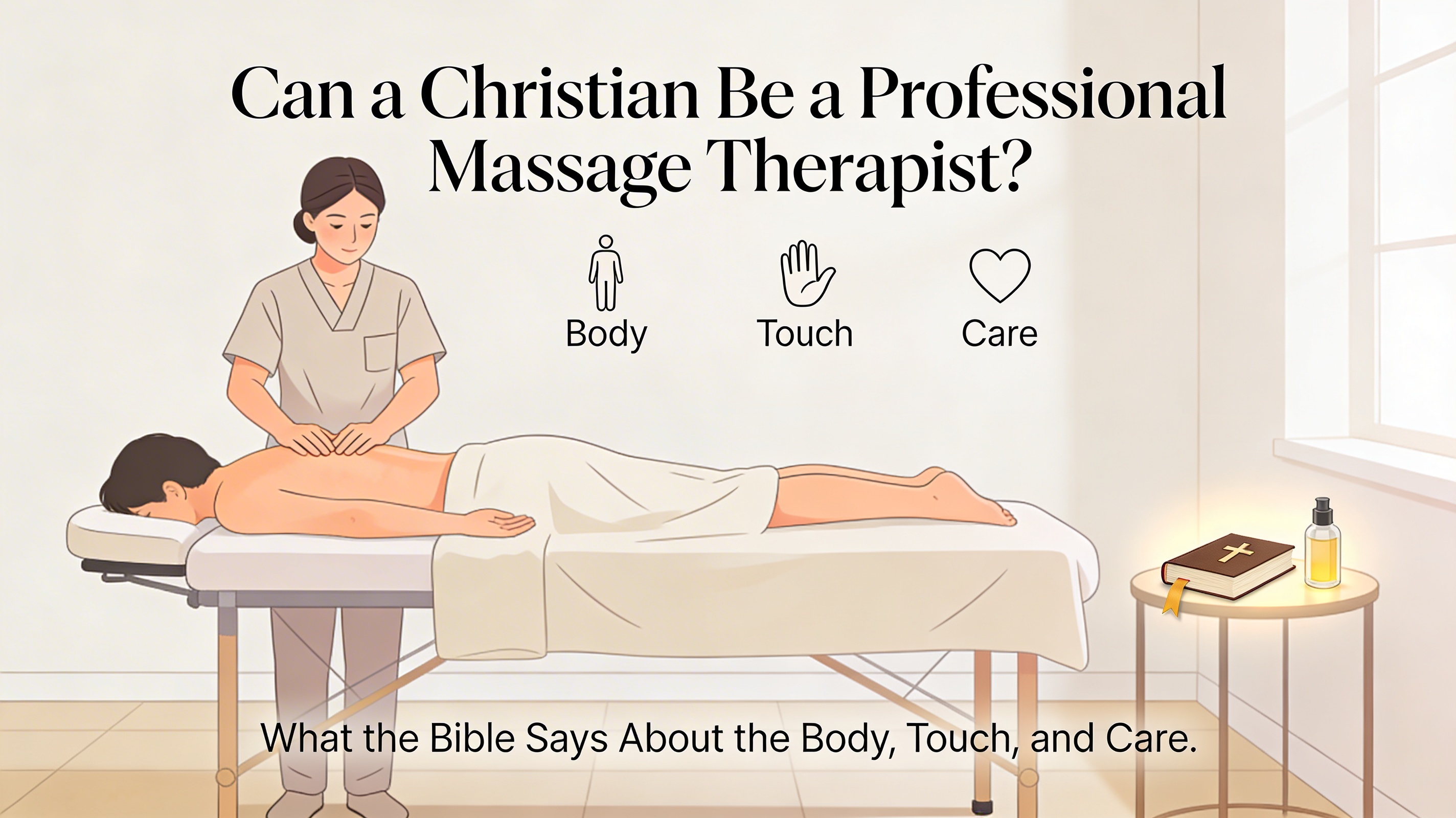
The question may seem trivial at first glance. Yet it touches on realities that run deep for a believer: the human body, the act of touching another person, the boundary between care and intimacy, and the legitimacy of a profession that engages all three at once. Can one, in good biblical conscience, make the body one's daily professional terrain? The Bible's answer is richer and more nuanced than many might expect.
A Question That Deserves a Serious Answer
In some Christian circles, wariness toward professional massage is real. It stems from several overlapping concerns: the possible confusion with practices that carry sexual connotations, the physical proximity with individuals of the opposite sex, and sometimes the association of massage with alternative spiritualities or energetic therapies rooted in esoteric traditions. These concerns are not all unfounded — they call for serious discernment. But they are not enough to disqualify the profession itself.
To answer rightly, we must begin where the Bible begins: the theology of the body.
What the Bible Says About the Human Body
1. The Body Is Good, Created and Honored by God
From the very first pages of Genesis, God forms the human body with his own hands and breathes life into it:
"Then the Lord God formed a man from the dust of the ground and breathed into his nostrils the breath of life, and the man became a living being."— Genesis 2:7
This verse establishes a foundational truth: the body is not a prison for the soul, nor an obstacle to spirituality — it is a divine creation, fashioned with intention. The Christian tradition, contrary to the gnostic dualisms that have sometimes crept into popular piety, does not teach that the body is evil or secondary. It is good because God made it good. Working with the human body — observing it, understanding it, caring for it — is therefore not, in itself, an impious activity.
The professional massage therapist who works within a therapeutic framework is working with what God created. There is nothing in that act which is inherently contrary to faith.
2. The Believer's Body Is a Temple of the Holy Spirit
The apostle Paul makes one of the highest declarations in all of Scripture about the human body:
"Do you not know that your bodies are temples of the Holy Spirit, who is in you, whom you have received from God? You are not your own."— 1 Corinthians 6:19
This statement carries a double weight for our subject. On one hand, it elevates the body to an extraordinary dignity: it is the dwelling place of the divine presence. Far from undermining the legitimacy of physical care, this actually strengthens it. To care for a body — to relieve its tensions, to support its healing, to restore its function — is to honor something sacred.
On the other hand, this same dignity imposes clear limits. If the body is a temple, then anything that defiles it — any touch that degenerates into lust, any practice that instrumentalizes it for illegitimate pleasure — is a serious fault. The holiness of the body is not an argument against massage; it is the very argument that defines the conditions under which massage must be practiced. A Christian massage therapist must make this theological conviction the foundation of their professional ethics.
3. Caring for Others as a Christian Vocation
The Gospel of Luke presents Jesus healing through touch on numerous occasions. The parable of the Good Samaritan, one of the most well-known in all of the New Testament, perfectly illustrates the Christian vocation to care:
"He went to him and bandaged his wounds, pouring on oil and wine. Then he put the man on his own donkey, brought him to an inn and took care of him."— Luke 10:34
The Samaritan does not merely feel compassion from a distance. He draws near, he touches, he tends. The oil poured on the wounds was both antiseptic and soothing — a gesture of practical medicine as much as of compassion. This biblical scene shows that physical, concrete, hands-on care is fully integrated into the Christian vision of loving one's neighbor.
A professional massage therapist who relieves chronic pain, helps a patient regain mobility after an injury, or reduces the stress of an exhausted body stands within this long tradition of care as an expression of love. Their profession can be a vocation, not merely a job.
4. Working with Integrity in All Circumstances
The apostle Paul, in his letter to the Colossians, addresses the workers of his day with an instruction that crosses the centuries:
"Whatever you do, work at it with all your heart, as working for the Lord, not for human masters."— Colossians 3:23
This verse does not speak of specific professions — it speaks of all of them. It establishes a principle of universal integrity: any human activity, whatever it may be, can be performed as an act of service rendered to God. A Christian massage therapist does not need to apologize for their profession. They are called to practice it with excellence, purity of intention, respect for the client, and uprightness of conduct — and in doing so, their work becomes an offering.
The Boundaries That Faith Requires: Necessary Discernment
Affirming that the profession of massage therapist is compatible with Christian faith does not mean it is free of moral risk. Discernment is required on several specific points.
The first question concerns the nature of the practice. Therapeutic massage — physiotherapy, wellness massage, structural reflexology — has nothing to do with establishments that use the word "massage" as cover for paid sexual services. A Christian must work in structures whose reputation and practices are clear and beyond reproach, and must categorically refuse any drift toward the erotic or sexual.
The second question concerns the spiritual framework of certain practices. Some types of massage are associated with philosophies or spiritualities incompatible with Christian faith — particularly those that mobilize concepts of energy, chakras, or invoke spiritual forces outside the biblical framework. A believer must carefully evaluate what they practice and what they communicate through their hands. Caring for a body is not the same thing as adhering to an esoteric cosmology.
The third question is one of personal purity. Working regularly with another person's body requires spiritual and emotional maturity. Lust, inappropriate attachment, or confusion of roles are real risks that the believer must take seriously — not in order to abandon the profession, but in order to enter it with vigilance, prayer, and, if necessary, accountability within a community of faith.
Conclusion: A Possible Vocation, A Demanding Ethics
The Bible does not condemn professional massage. On the contrary, it offers a theology of the body rich enough to ground a dignified and respectful practice of care. The human body is a divine creation, precious and sacred. To take charge of it, help it heal, and restore its suppleness and comfort can be a deeply Christian act — provided it is done with purity of heart, professional integrity, and spiritual clarity.
A Christian can therefore practice the profession of massage therapist. But as with any vocation, it is not only thewhatthat matters — it is thehow, thewhy, and thein what framework. Where those three questions receive answers rooted in faith, professional massage therapy can be a ministry of care in its own right.